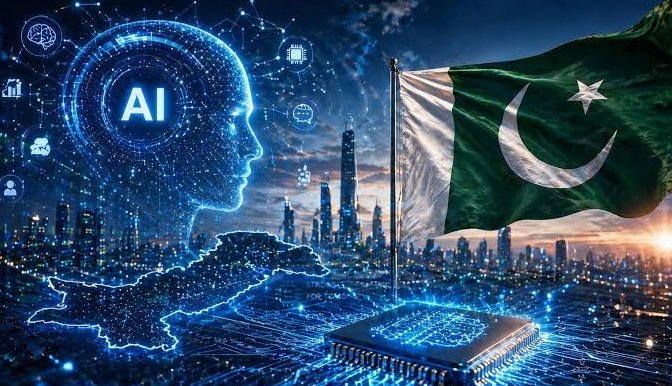
Pakistan is becoming a major provider of artificial intelligence services in the Middle East, North Africa, Afghanistan and Pakistan region, the World Bank says. It is now one of the top five suppliers of services on major online platforms, offering skills in more than 2,700 areas, and is building its own AI industry at home.
The country is focusing on selling AI services based on its talented workers. About 75,000 students graduate in IT every year, and Pakistan earned a record $4.6 billion from ICT services in fiscal year 2025/26. It is also creating “small AI” tools that work in local languages and fit local needs. Pakistan and Egypt are among the top five global suppliers of services on major online platforms, according to the World Bank.
Working in global online markets gives Pakistani workers big opportunities, but it also makes them vulnerable, because AI is starting to replace some jobs that used to be done by people. Pakistan is also becoming a major home for data centers, with the most data centers in the region after Saudi Arabia and the UAE.
Pakistan’s AI goals go beyond selling services online. The World Bank says the country wants “AI sovereignty” — meaning it wants to build its own AI systems at home to support national goals. A $1 billion program running until 2030 aims to build shared GPU infrastructure, create a national AI model that works in many languages, fund 1,000 AI PhD scholarships and train 1 million non-IT professionals. Pakistan is one of 14 of 21 countries in the region that have published a national AI strategy.
The strategy focuses on agriculture, including using AI to manage pesticides and fertilizer, handle irrigation, estimate crop yields, make trade decisions and improve food security. It also looks at social risks, such as gender bias, the gap between men and women in digital access, and wage gaps. Data privacy and weak regulations are other concerns. Pakistan also aims to train 200,000 people in AI every year and provide 3,000 postgraduate scholarships.
The World Bank said Pakistan performs strongly on digital infrastructure compared with similar-income countries, but weakly on innovation and economic integration. Middle-income countries like Pakistan are in the middle — they have growing technical skills and big ambitions, but also major problems putting their plans into action.
The region’s biggest weakness is in rules and institutions, and weak private-sector activity is another big problem.
Only about 24% of companies in the region invest in physical capital, compared with 37% outside the region, and just 19% offer formal training, compared with 30% outside. The bank said fixing the private sector is essential for AI to drive economic growth.
For Pakistan, the growth of AI brings both opportunities and risks, because the country has many service workers and depends heavily on global freelance and outsourcing markets. Pakistan had the highest number of AI-related conversations in the region, but most were about arts and media — like graphic design, content creation and translation — not software development. Demand for digital and AI skills has also risen sharply, and Pakistan was among the countries with double-digit percentage-point increases in job postings asking for digital skills between 2021 and 2025.
The World Bank said AI is more likely to help workers in the region than replace them, at least for now. Automation affects about 0% to 10% of jobs in the region, with the lowest shares in Afghanistan and Pakistan. On the other hand, 13% to 20% of jobs could be improved by AI, where the technology helps workers instead of replacing them.
University graduates in Pakistan face higher exposure to AI, because they tend to work in cognitive jobs that AI can do more easily. Women in Pakistan have lower overall exposure, because they work more often in jobs that are less affected by AI, such as crafts, basic jobs, and skilled farming, forestry and fishing work. Jobs exposed to AI are also concentrated in government and public companies in Pakistan and several other countries in the region, the World Bank said.
The World Bank said AI is quickly moving from a new technology to a general tool that affects businesses, workers, governments and individuals. For developing countries like Pakistan, the key questions are how fast AI will spread, who will be able to use it well, and whether it will close or widen existing gaps in productivity and opportunity.
Pakistan has a large digitally skilled workforce, growing data-center infrastructure, rising online services exports and a government-backed $1 billion AI program. But it still has big gaps in innovation, regulation and private-sector capacity, which could determine how well it turns its AI ambitions into real economic gains.