
KARACHI: A former Additional Commissioner of the Inland Revenue Service, now a practising advocate, has written to the Chairman of the Federal Board of Revenue (FBR) and Secretary, Revenue Division, demanding a detailed public accounting of the billions of rupees obtained from international lenders for tax reforms, how they were spent, and what they achieved. The 42-point request also raises the alleged collapse of morale among FBR officers after the suspension and transfer of nine officers on 19 and 20 October, and warns that this could damage the Rs15,264 billion revenue target for 2026-27.
The Request at a Glance
Asif Ali Abro, Advocate has addressed a letter to the “Learned Chairman FBR / Secretary Revenue Division, Islamabad”.
The subject line reads: Information Request under Section 11 read with Section 6 of the Right of Access to Information Act 2017, read with Article 19A of the Constitution of Pakistan 1973.
The applicant states that he is a citizen of Pakistan and a practising lawyer, and that the information is being requested in the public interest. He asks for a response within 10 working days of receipt of the letter, “in larger interest of justice and equity”. A copy has been sent “for information and necessary action” to the Secretary to the Prime Minister of Pakistan.
The letter is organised in 14 numbered paragraphs. Paragraphs 1 to 10 set out the background and the applicant’s concerns, paragraph 11 lists seven adverse findings on reform results and workforce morale, and paragraph 12 contains 42 numbered information requests (I to XLII).
An important note: the letter’s assertions are those of the applicant. Several are marked by him as “subject to verification”, and the FBR had not, at the time of writing, responded publicly to the letter.
________________________________________
The Financing Background
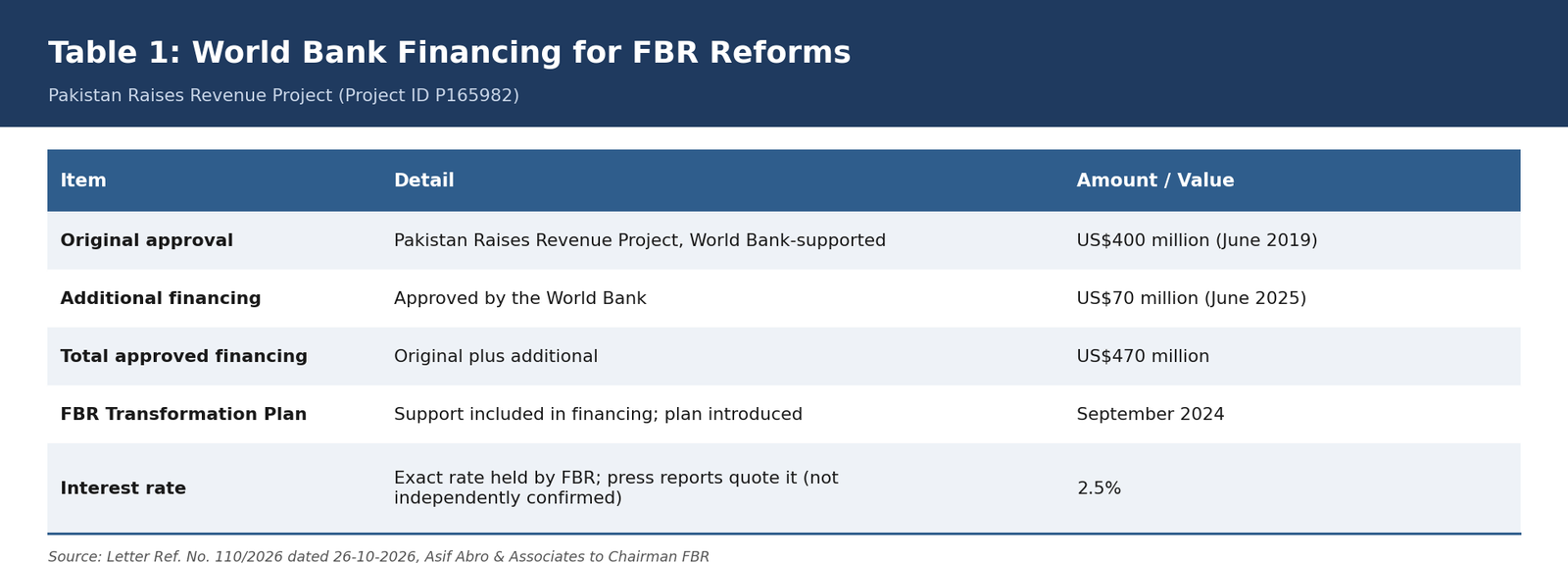
The letter begins with the foreign financing behind the reform effort. It notes that the FBR has been the beneficiary of substantial external financing under the World Bank-supported Pakistan Raises Revenue Project (Project ID P165982).
- The project was originally approved in June 2019 with financing of US$400 million.
- In June 2025, the World Bank approved additional financing of US$70 million, raising the total approved financing to US$470 million.
- The financing includes support for the FBR Transformation Plan, introduced in September 2024.
The applicant says the exact information on total funding for FBR reforms, and the exact interest rate on these foreign funds, is held by the FBR. He adds that press reports quote an interest rate of 2.5 per cent, a figure he does not independently confirm.
A separate table of these figures is provided as an image alongside this article (Table 1).
________________________________________
The Applicant’s Argument: Priorities and Mindset
Beyond the numbers, the letter makes two broader arguments.
On national priorities. The applicant says Pakistan is well aware of what he calls “Indian war designs” against the country. He says warfare has entered the domain of new weaponry in the form of modern drones, “as witnessed during our last war against India in which hundreds of drones were fired against Pakistan”, and that Pakistan needs funds to accelerate the pace of acquiring new defence-related modern equipment such as drones. He adds that the cost of fighting terrorism “has touched skies”, citing the near-daily shahadat of soldiers, and that poverty has reached an alarming level. Against this backdrop, he writes, “it seems that the spending of interest-based foreign funds on FBR Reforms is wastage of precious resources of the nation.”
On institutional reform. The applicant argues that reform of national institutions such as the FBR requires a change in the mindset of officers. In his view, that mindset could be changed by inculcating the traditions of the Holy Prophet (P.B.U.H), the Khulafa-e-Rashideen (A.S), the Ahl-e-Bait (A.S), and the philosophy of Hazrat Allama Iqbal and Hazrat Quaid-e-Azam. He contends that foreign funds cannot change the mindset of people, and that they can instead result in the “personal enrichment of the concerned”.
________________________________________
What the IMF Report Says, According to the Letter
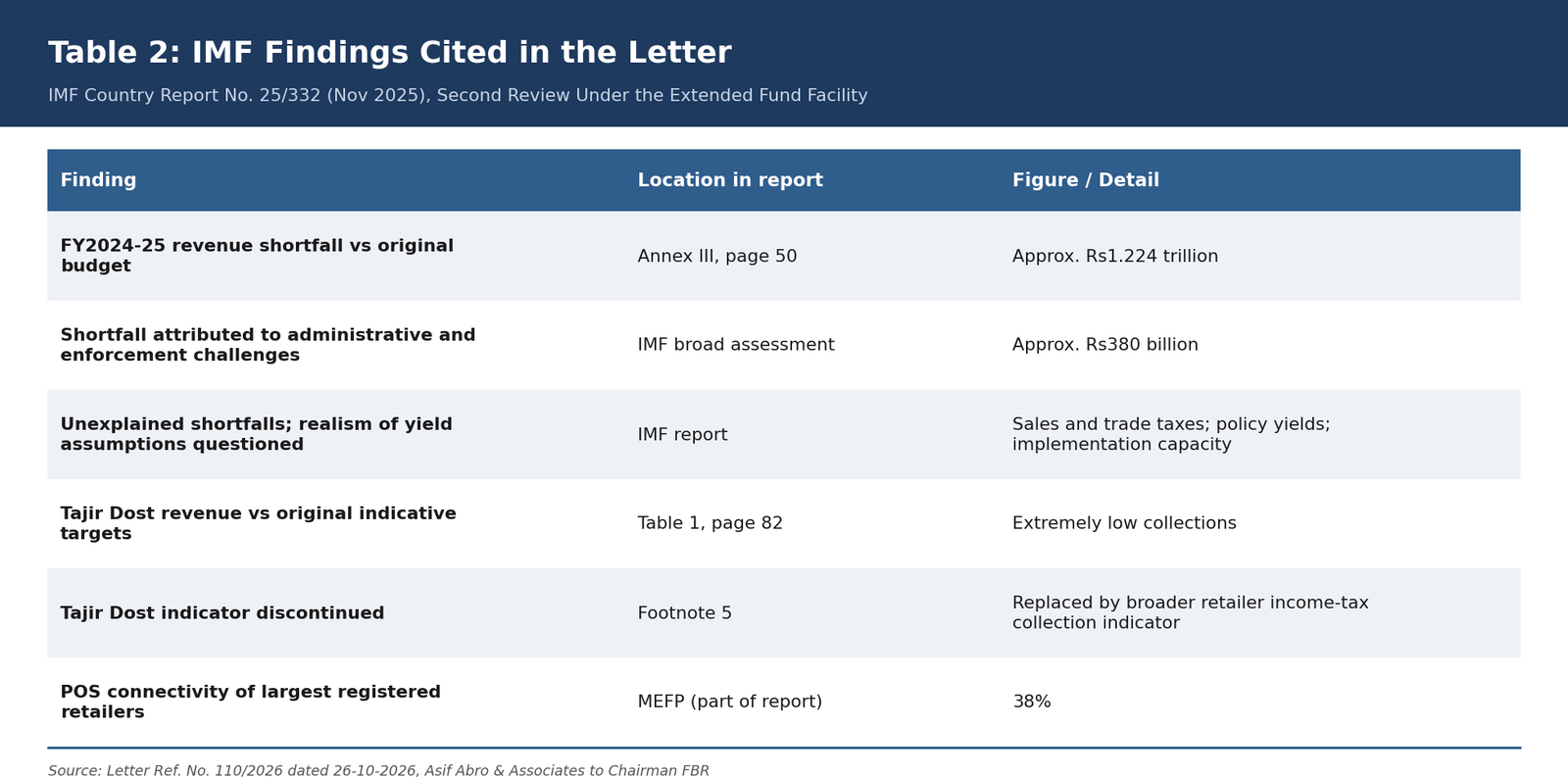
The applicant says serious concerns about the effectiveness of the FBR’s revenue administration reforms are supported by the findings of the International Monetary Fund (IMF) itself. He relies on the IMF report titled Pakistan: Second Review Under the Extended Fund Facility, IMF Country Report No. 25/332 (November 2025). According to the letter:
- The shortfall. Annex III, page 50, records that the FBR’s revenue collection for FY2024-25 fell short of original budget projections by approximately Rs1.224 trillion.
- Administrative causes. The IMF attributed approximately Rs380 billion of the shortfall, on a broad assessment, to administrative and enforcement challenges that remained unresolved throughout the financial year.
- Unexplained gaps and optimism. The IMF further identified substantial unexplained shortfalls in sales and trade taxes and questioned the realism of assumptions about the expected revenue yields of policy measures and about implementation capacity.
- Tajir Dost. Table 1 on page 82 records extremely low revenue collections against the scheme’s original indicative targets. Footnote 5 confirms that the separate Tajir Dost revenue indicator was subsequently discontinued and replaced with a broader retailer income-tax collection indicator.
- Point-of-sale connectivity. The Memorandum of Economic and Financial Policies (MEFP), which forms part of the report, records that POS connectivity covered only 38 per cent of the largest registered retailers at the relevant time.
These statistics are collected in Table 2 of the accompanying images.
________________________________________
The Seven Findings the Applicant Calls a “Black Picture”
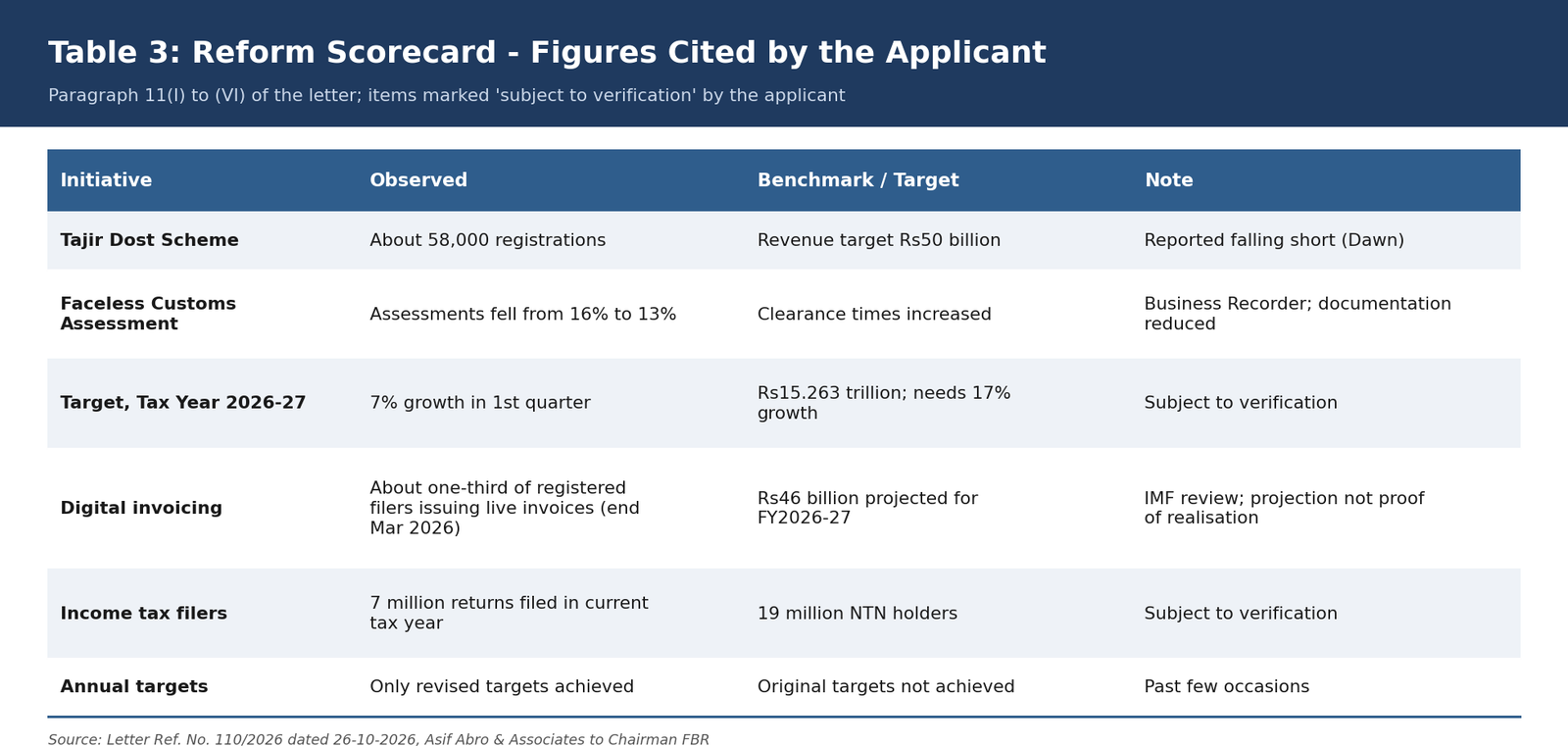
Paragraph 11 of the letter states that other results of the FBR reforms “paint a black picture”, and lists seven observations. Table 3 summarises the numerical ones.
- Tajir Dost Scheme
The scheme drew only about 58,000 registrations, according to reports, and was said to be falling short of its revenue target of Rs50 billion. The applicant says information can be obtained on how much has been spent on the scheme so far. He cites a Dawn article titled “Inequitable taxation” (dawn.com/news/2036808).
- Faceless Customs Assessment (FCA)
Customs assessments dropped from 16 per cent to 13 per cent after FCA implementation. The letter says the system has increased clearance times despite reducing documentation requirements. The source cited is a Business Recorder report (brecorder.com/news/40365235) whose headline, as it appears in the link, describes an internal review labelling the FCA system a “complete failure”.
- III. Tax Year 2026-27 target
The current target is Rs15.263 trillion (the information requests elsewhere in the letter use Rs15,264 billion). The letter says the target requires 17 per cent growth, but only 7 per cent growth has been observed in the first quarter so far (subject to verification). The applicant concludes that the current year’s target “is very difficult”.
- Digital invoicing
At the end of March 2026, only around one-third of registered sales tax filers were issuing live digital invoices, according to the IMF review. The same report projected Rs46 billion in additional revenue from digital invoicing in FY2026-27, but the applicant stresses that the projection “is not proof that the revenue has been realized”. The source given is an IMF eLibrary link (elibrary.imf.org, 2026/101).
- Filers
Only 7 million income tax returns have been filed in the current tax year, even though there are 19 million NTN holders (subject to verification).
- Revised annual targets
On past occasions, only the revised targets could be achieved. “Hence”, the letter says, the original revenue targets could not be achieved.
VII. Lowest morale of the FBR workforce (IRS and Customs)
This is the most pointed section of the letter and is covered in full below.
________________________________________
Morale and Service Structure: The Applicant’s Allegations
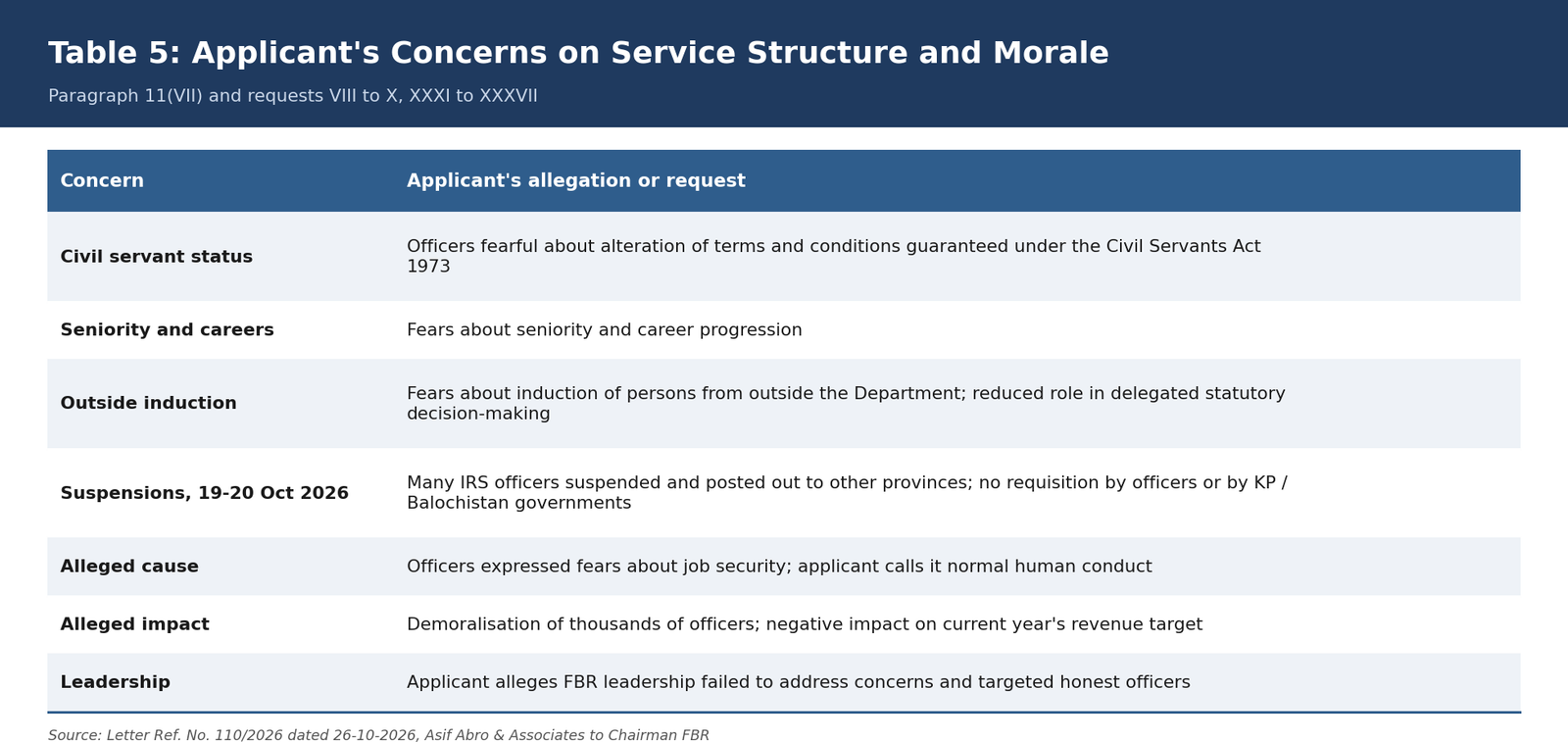
The applicant says FBR officers are in a state of “grave fear” about their status as civil servants under the Civil Servants Act 1973. According to the letter, they are fearful about:
- alteration in the terms and conditions of their service as guaranteed under the Act;
- matters relating to their seniority and career progression;
- the “induction of persons from outside their Department”; and
- their reduced role in delegated statutory decision-making.
The suspensions of 19 and 20 October 2026
The letter alleges that on 19-10-2026 and 20-10-2026, many “honest and brilliant” officers of the IRS (FBR) were suspended and posted out to other provinces as “punishment”. It says neither the officers nor the respective provincial governments of Khyber Pakhtunkhwa or Balochistan had made a requisition for their services.
The applicant claims the only “offence” of these officers was the “expression of their fears” about their job security, “which is a normal human conduct”. He warns that such mishandling will result in the demoralisation of thousands of FBR officers, which “will negatively impact the Revenue Target of current year”.
He goes further, alleging that the current FBR leadership has “failed miserably” to alleviate officers’ concerns about service-related matters, and that, in order to cover up this management failure, honest and active officers have been targeted by that leadership. He says the facts about the honesty and uprightness of the concerned officers could be verified from any other federal agency, such as the IB, MI or ISI.
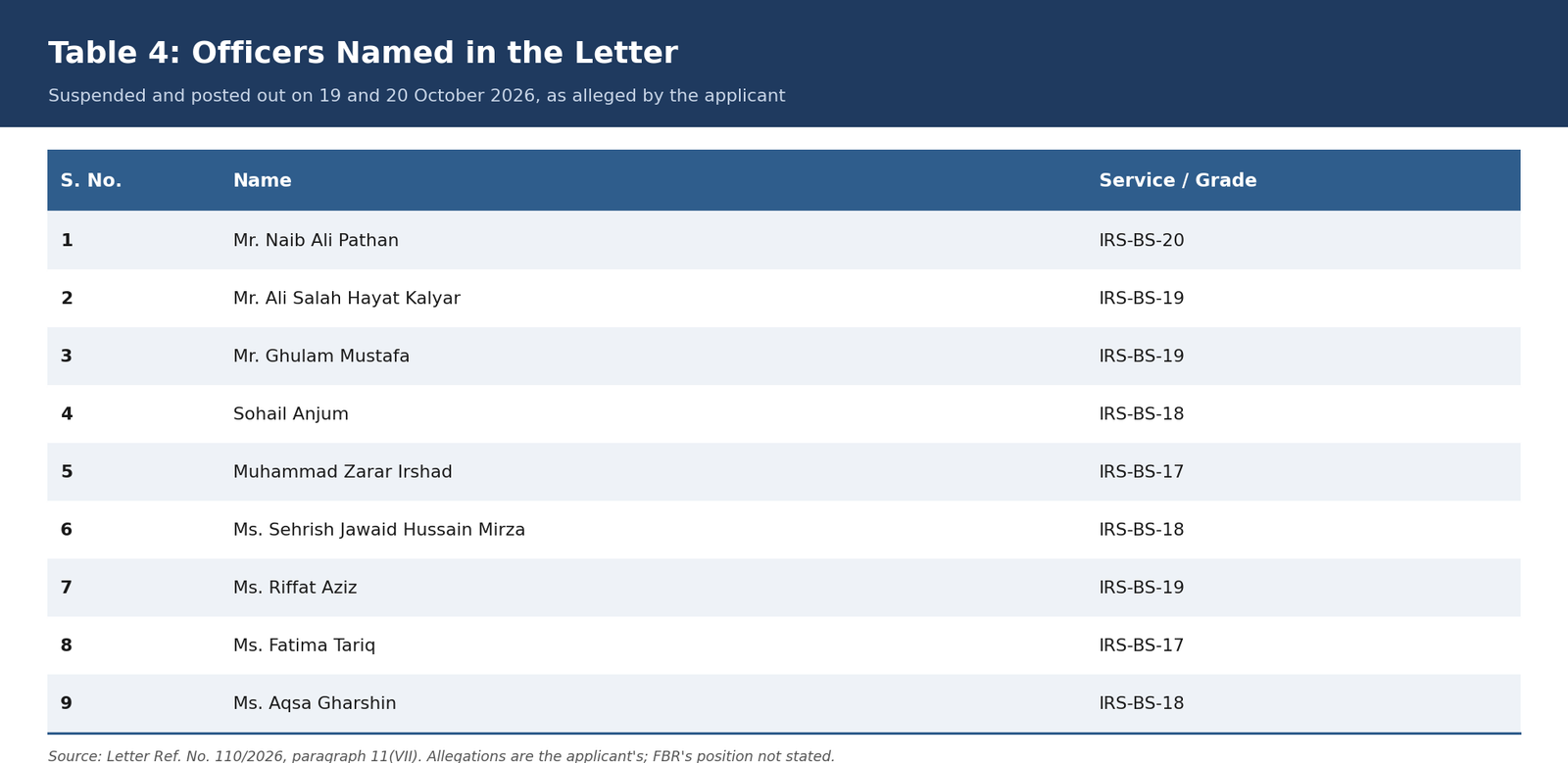
The nine officers named in the letter
Table 4 lists the officers named, with their grades:
- Mr. Naib Ali Pathan (IRS-BS-20)
- Mr. Ali Salah Hayat Kalyar (IRS-BS-19)
- Mr. Ghulam Mustafa (IRS-BS-19)
- Sohail Anjum (IRS-BS-18)
- Muhammad Zarar Irshad (IRS-BS-17)
- Ms. Sehrish Jawaid Hussain Mirza (IRS-BS-18)
- Ms. Riffat Aziz (IRS-BS-19)
- Ms. Fatima Tariq (IRS-BS-17)
- Ms. Aqsa Gharshin (IRS-BS-18)
The FBR’s version of events, including the grounds for the orders, has not been made public in the letter, and the officers’ own statements are not part of it.
________________________________________
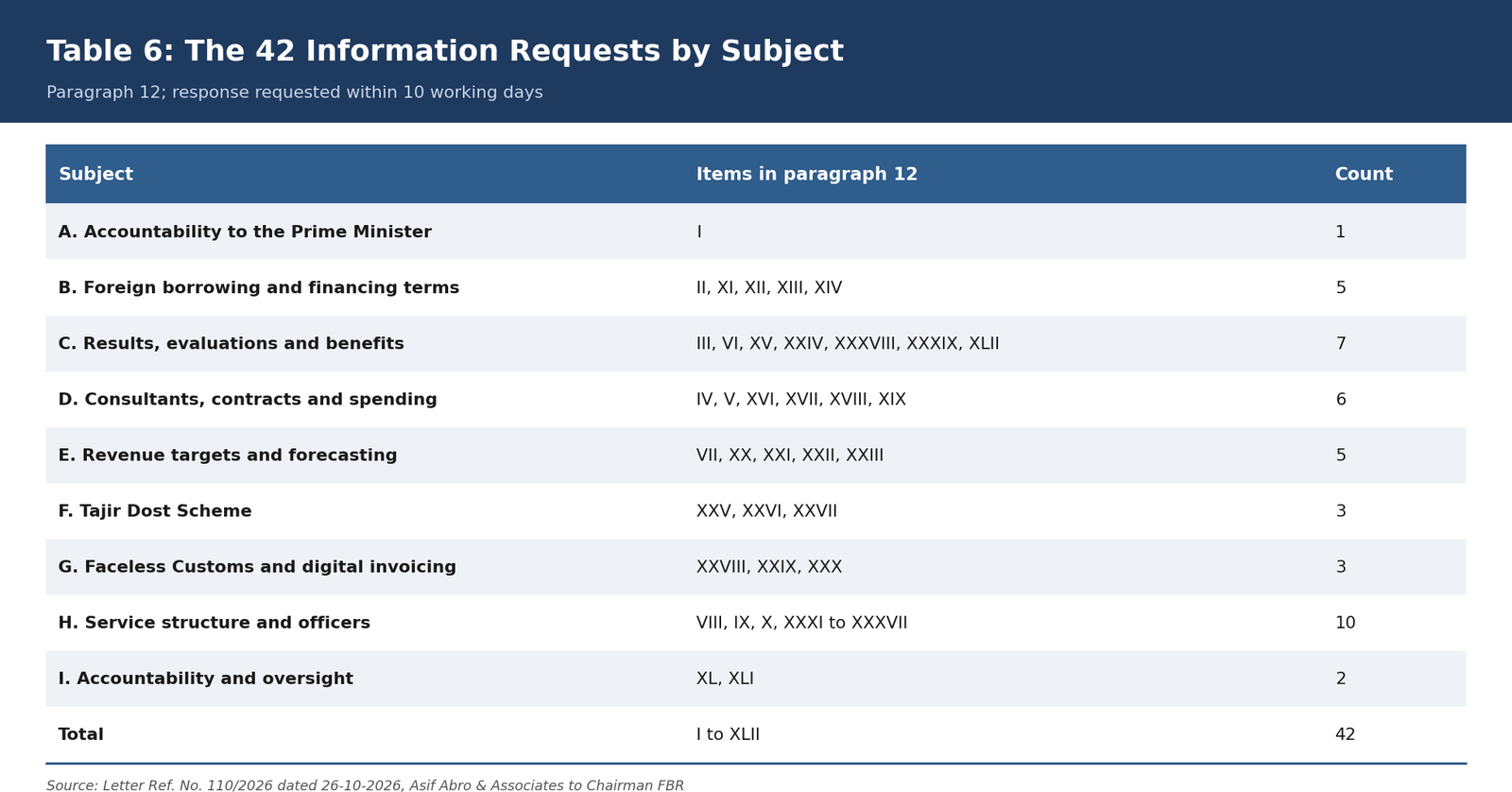
The 42 Questions: What the Applicant Wants Disclosed
Paragraph 12 asks the FBR, “in the light of the supra-mentioned facts”, to provide information “in public interest”. The 42 items are summarised below in the order of the letter, grouped by subject. Table 6 shows the same grouping with item counts.
- Accountability to the Prime Minister (item I)
- I. Whether the Prime Minister of Pakistan has been “kept in dark” and has not been shown the real picture of the actual results of the FBR reforms on which billions of rupees have been spent.
- Foreign borrowing and financing terms (items II, XI, XII, XIII, XIV)
- II. How much has been obtained from the World Bank, the IMF or any other international donor or local bank from June 2019 to October 2026, especially from 8 August 2024 to October 2026, together with the exact interest rate on it.
- XI. A project-wise and financial-year-wise statement of all foreign loans, credits, grants and other financing obtained or used for FBR reforms from 1 July 2019 to 25 October 2026, distinguishing approved financing, amounts disbursed, amounts actually spent and unutilised balances.
- XII. Certified copies of the original financing agreements, additional financing agreements and amendments, showing interest or service charges, commitment charges, repayment schedules, grace periods and other financial obligations of the Government of Pakistan.
- XIII. Records showing the total interest, service charges, commitment charges and other financing costs already paid, accrued or payable, together with the authority responsible for repayment.
- XIV. The financial and economic appraisals, cost-benefit analyses and feasibility studies carried out before approval of the Pakistan Raises Revenue Project and the subsequent US$70 million additional financing.
- Results, evaluations and benefits (items III, VI, XV, XXIV, XXXVIII, XXXIX, XLII)
- III. Certified copies of all internal and external performance evaluations, project completion reports, audit observations and assessments showing the extent to which the objectives of each reform initiative were achieved, partially achieved or not achieved, with the expenditure against each objective.
- VI. An explanation of why, despite huge funds, the reforms have failed to meet the desired objectives.
- XV. Records showing whether the financial benefits of reforms have been assessed against the costs incurred, including financing costs, and copies of any such assessments.
- XXIV. Records of performance reviews by the FBR Board, the Chairman FBR or the Revenue Division on the implementation and results of the FBR Transformation Plan since September 2024.
- XXXVIII. Approved terms of reference, responsibility matrices, monitoring arrangements and performance indicators assigning responsibility for implementing and overseeing each major reform initiative.
- XXXIX. Independent evaluations, third-party monitoring reports, World Bank implementation-support reports and departmental reviews assessing achievement of reform objectives, with the official responses to their recommendations.
- XLII. Available records showing which reform initiatives have achieved their approved performance indicators, which have not, and the amount spent on each as of 25 October 2026.
- Consultants, contracts and spending (items IV, V, XVI, XVII, XVIII, XIX)
- IV. Which firms or consultants have been hired through contracts or agreements, and on what terms and conditions, from June 2019 to October 2026, especially from 8 August 2024, with copies of the agreements.
- V. Programme-wise expenditure, including consultant costs, procurement, technology and implementation costs and other related expenditure, with copies of relevant bills and invoices since June 2019.
- XVI. The complete list of consultants, advisory firms, IT companies and other contractors engaged for reforms since July 2019, indicating procurement method, contract value, payments released, deliverables and completion status.
- XVII. Procurement evaluation reports, contract award decisions, approved variations, extensions and performance evaluation reports for those engagements.
- XVIII. Audit objections, procurement irregularity reports, investigations, recovery recommendations or disciplinary proceedings relating to expenditure under reform projects, with their present status.
- XIX. Records identifying which consultancy recommendations were accepted, rejected or implemented, and the expenditure on consultancy assignments whose recommendations were not implemented.
- Revenue targets and forecasting (items VII, XX, XXI, XXII, XXIII)
- VII. Whether the current year’s (2026-27) revenue target of Rs15,264 billion will be achieved by the FBR as originally set.
- XX. Original targets, revised targets and actual collections, separately for Income Tax, Sales Tax, Federal Excise Duty and Customs Duty, for each financial year from 2019-20 to 2025-26.
- XXI. Internal reviews, performance assessments and reports identifying the causes of shortfalls against original targets in those years, including findings on tax policy, administration, enforcement and economic conditions.
- XXII. The revenue forecasting models, assumptions, administrative measures and documented risk assessments relied upon in fixing the original FY2026-27 target of Rs15,264 billion.
- XXIII. Month-wise targets and actual collections for July, August and September 2026, with the relevant internal quarterly performance review and any approved corrective action plan.
- Tajir Dost Scheme (items XXV, XXVI, XXVII)
- XXV. The original feasibility studies, revenue projections, implementation plans and approved budgets for the scheme.
- XXVI. Total expenditure on the scheme, including publicity, staffing, technology, consultancy and operational costs, together with total revenue collected specifically under it, to the extent separately recorded.
- XXVII. Official reviews or decisions on modifying, discontinuing or replacing the scheme’s original performance indicators.
- Faceless Customs Assessment and digital invoicing (items XXVIII, XXIX, XXX)
- XXVIII. Approved performance indicators for Faceless Customs Assessment, including baseline and subsequent data on assessment time, clearance time, assessment accuracy, valuation disputes, appeals and revenue collection.
- XXIX. Internal assessments, inspection reports and evaluation studies on the operational effectiveness of FCA, including adverse findings and corrective measures.
- XXX. The approved cost, actual expenditure, implementation milestones, number of taxpayers integrated and recorded additional revenue attributable to the digital invoicing initiative, with the methodology used for attribution.
- Service structure and officers (items VIII, IX, X, XXXI to XXXVII)
- VIII. Whether steps are being taken or decisions made that alter the terms and conditions of service of IRS and Customs officers as guaranteed under the Civil Servants Act 1973.
- IX. Whether steps or decisions could negatively affect the seniority and career progression of IRS and Customs officers.
- X. Whether persons from outside the FBR, without tax-related knowledge and experience, are being inducted.
- XXXI. Certified copies of approved proposals, summaries, notifications, Cabinet decisions, Establishment Division correspondence and legal opinions on any proposed restructuring, corporatisation, privatisation or alteration of the legal status of the FBR or its officers.
- XXXII. Proposals or decisions on creating any new executive service, cadre, management structure or lateral-entry arrangement affecting IRS or Pakistan Customs Service officers.
- XXXIII. Approved proposals, rules or decisions on changes to seniority, promotion, posting, transfer, the disciplinary framework or other terms and conditions of service of IRS and Customs officers.
- XXXIV. The applicable rules, approved criteria and competent-authority orders governing induction or appointment of persons from outside IRS and Pakistan Customs Service to positions involving revenue administration or statutory decision-making.
- XXXV. Copies of the orders and recorded grounds for the suspensions, transfers and postings issued on 19 and 20 October 2026 for the IRS officers identified in paragraph 11(VII).
- XXXVI. Relevant Establishment Division correspondence, departmental proposals, approvals and notifications on those transfers or postings, including any records of consultation with the receiving governments or departments.
- XXXVII. Any approved assessment of the effect of the FBR Transformation Plan on the career progression, statutory functions and terms and conditions of service of IRS and Customs officers.
- Accountability and oversight (items XL, XLI)
- XL. Records of accountability proceedings, recovery actions, contract remedies or administrative measures initiated after findings of material procurement irregularities, financial losses or non-performance under reform projects.
- XLI. Minutes, decisions and action-taken reports of FBR Board or other competent oversight-body meetings at which delays, underperformance, cost overruns or material risks concerning reforms were considered.
________________________________________
Legal Basis and Deadline
The request invokes Section 11 read with Section 6 of the Right of Access to Information Act 2017 and Article 19A of the Constitution, which guarantees citizens the right of access to information in all matters of public importance, subject to regulation and reasonable restrictions imposed by law. The applicant asks that the information be provided within 10 working days after receipt of the letter or notice, “of earlier in larger interest of justice & equity”. The letter closes with the line: “Looking forward for your cooperation in the matter.”
It is signed by Asif Ali Abro, Advocate (SBC Regd. No. 52637). The copy to the Secretary to the Prime Minister is marked “for information and necessary action”. Contact details on the letterhead: Room No. 41, 4th Floor, Fareed Chambers, Abdullah Haroon Road, Saddar, Karachi; tel. 0331-5085775.
________________________________________
Points to Note
- Allegations, not findings. The claims about the nine officers, the leadership of the FBR, and the outcome of reforms are the applicant’s own. The letter itself marks several figures (first-quarter growth of 7 per cent and the 7 million versus 19 million returns/NTN comparison) as “subject to verification”.
- Target figure. The letter cites the 2026-27 target as Rs15.263 trillion in one place and Rs15,264 billion in others.
- Press-sourced figures. The 2.5 per cent interest rate, the 58,000 Tajir Dost registrations, the Rs50 billion target and the FCA assessment figures are attributed to press reports or the sources the applicant cites.
- Awaiting response. At the time of writing, no response from the FBR or the Revenue Division to the letter had been reported. The statutory response period requested is ten working days.