
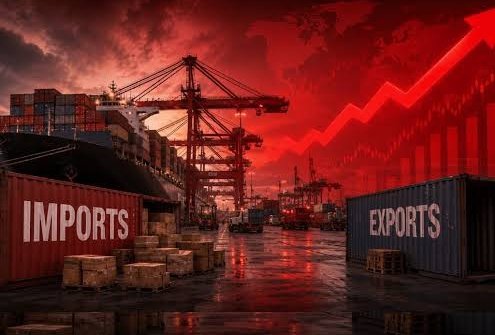
ISLAMABAD: Pakistan recorded a trade deficit of $3.88 billion in October 2026, a nearly 20% increase from the same month last year, according to Pakistan Bureau of Statistics data released Friday.
The gap between exports and imports was $3.24 billion in October 2025.
Rising imports combined with weak export growth drove the year-on-year widening.
Exports edged up 2.8% to $2.93 billion from $2.85 billion in October 2025, while imports climbed nearly 12% to $6.81 billion from $6.09 billion.
Compared with September 2026, the deficit grew more than 10% from $3.52 billion, as imports rose and exports held steady.
For the first four months of fiscal year 2026-27, the trade deficit reached $14.63 billion, up nearly 16% from $12.61 billion a year earlier. Imports increased more than 12% to $25.96 billion from $23.06 billion, and exports rose more than 8% to $11.34 billion from $10.45 billion.
Pakistan depends heavily on imported fuel, machinery, chemicals and food, with petroleum products making up a large portion of the import bill and putting pressure on foreign exchange reserves. Automobile imports have also risen sharply.
The country’s exports are concentrated in traditional, consumer-based goods such as rice, raw cotton, textiles and leather, and its manufacturing sector leans toward low-value-added products. High energy tariffs, rising taxation, costly financing, policy uncertainty and declining competitiveness have weighed on exports.