
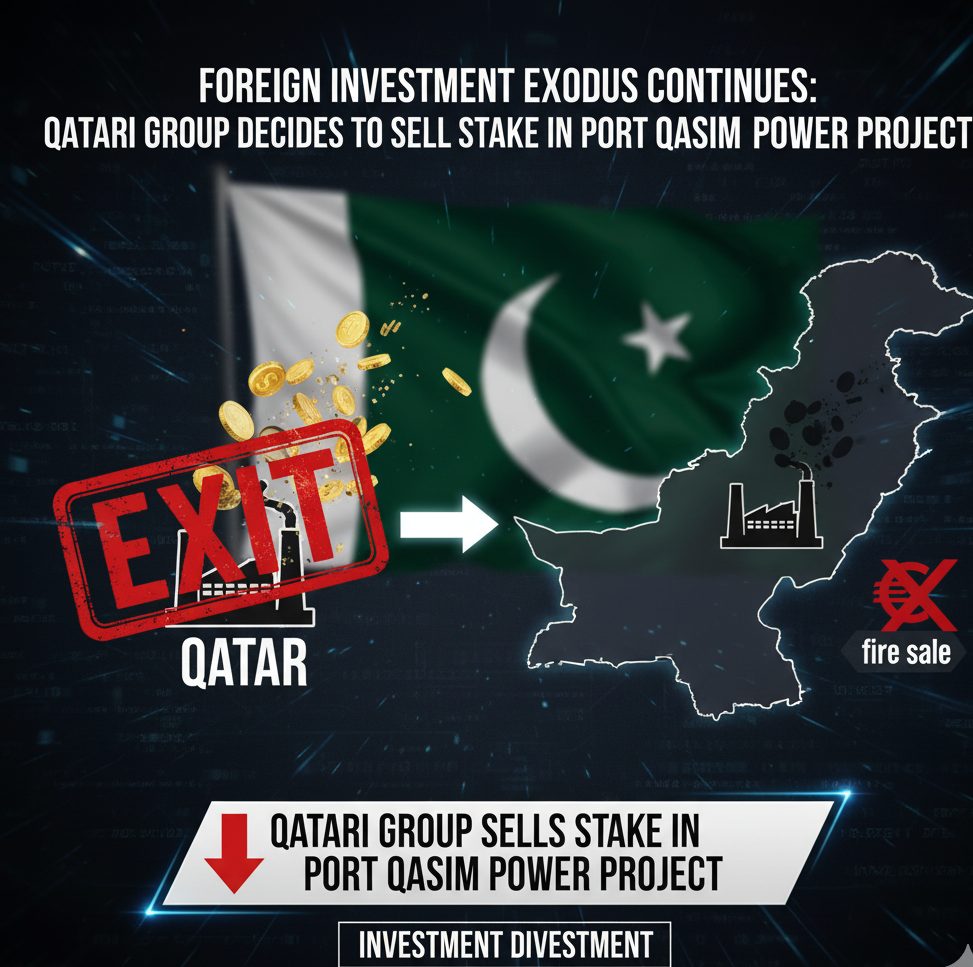
Pakistan is currently grappling with a severe crisis of dwindling Foreign Direct Investment (FDI), primarily due to economic instability and policy uncertainty. Several international companies are either selling their stakes or have decided to completely exit the Pakistani market.
Now, Qatar’s Al Thani Group has also signaled its intention to sell its 49% shareholding in the 1,320 MW Port Qasim Coal Power Plant. According to sources, the government has been formally informed of this decision.
The Port Qasim power project, built under the China-Pakistan Economic Corridor (CPEC), includes two 660 MW supercritical coal units. The $2.09 billion project spans 330.7 acres and is located about 37 km east of Karachi. It was completed through a joint venture between Qatar’s Al Mirqab Capital and China’s Power Construction Corporation (a subsidiary of Sinohydro Resources Limited). The Al Thani Group invested over one billion dollars in this project.
Like other Independent Power Producers (IPPs), the management of the Port Qasim Power Plant has consistently expressed serious concerns over continuous delays in the payment of dues by the Central Power Purchasing Agency Guaranteed (CPPA-G). These financial issues remain unresolved due to Pakistan’s ongoing foreign exchange crisis. Chinese project developers under CPEC are reportedly escalating pressure for the payment of their outstanding dues, which total approximately PKR 400 billion.
Recently, the management of Port Qasim Electric Power Company (PQEPC) warned the government that the plant’s operations could be suspended if CPPA-G fails to pay the dues as per the agreement. The company’s head, Mr. Dong Feng, cautioned senior government officials that the project’s suspension would be detrimental to all parties. Timely payment of dues is vital not only for sustained power generation but also for safeguarding loan agreements and Pakistan’s sovereign guarantees.
Last year, Prime Minister Shehbaz Sharif received a letter from former Qatari Prime Minister Sheikh Hamad bin Jassim bin Jaber Al Thani, demanding a $450 million payment in exchange for his company’s investment in the Port Qasim project. However, despite the involvement of the Prime Minister’s Special Assistant for Foreign Affairs, Tariq Fatemi, the amount has yet to be paid.
In the latest development, Al Mirqab Capital has formally informed high-ranking officials in Islamabad of its decision to exit the Port Qasim Power Project. This notification has also been conveyed to Federal Energy Minister Sardar Awais Ahmed Khan Leghari and Minister for Economic Affairs Senator Ahad Khan Cheema.
Al Mirqab Capital is the family office of Sheikh Hamad bin Jassim bin Jaber Al Thani, based in Doha, managing the Al Thani family’s global investment portfolio, including public equities, real estate, and private investments.
Sources indicate that the notice of intent to withdraw investment from the Port Qasim Power Plant has been formally delivered to the relevant authorities. When contacted, the company clarified that any future meetings or communication would be arranged through the same official channel through which the original letter was received.
Meanwhile, the investment climate in Pakistan continues to deteriorate. Nine international companies have exited the country over the past four years. These include four manufacturing companies—three pharmaceutical firms (Pfizer, Sanofi Aventis, and Eli Lilly) and one consumer goods company (Procter & Gamble). The remaining five companies belonged to the services sector, including Shell, Total, Telenor, and Uber/Careem.
However, Federal Energy Minister Sardar Awais Leghari denied this news, stating that he has not received any such information.