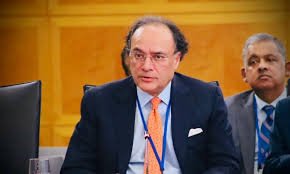
Federal Minister for Finance and Revenue Muhammad Aurangzeb said that the government’s primary focus is on structural reforms, which include taxation, restructuring of the energy sector, privatization of state-owned enterprises, governance reforms, and rationalization of federal expenditures.
In a meeting with a high-level delegation of the global leadership platform Dialogue, the Finance Minister highlighted the pace of Pakistan’s economic reforms. This platform was founded by Peter Thiel and Oren Hoffman.
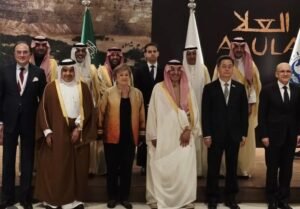
The delegation was led by Ambassador Ali Jahangir Siddiqui and included prominent global figures such as Simon Stevens (Member, UK House of Lords), White Valentin Dengler (Member of Parliament, Austria; Founder, Draw Solutions), Yasmin Green (CEO, Jigsaw Google), Fatima Kardar (Vice President, Xbox Microsoft), Shada Martine (CEO, Multi-Faith Alliance), Evan Marwell (CEO, Education Super Highway), and Himanshu Gulati (Member of Parliament, Norway), among others.
The Finance Minister appreciated Dialogue’s continued engagement with Pakistan, which since the first Dialogue Pakistan – Winter Event 2024 has contributed to better global understanding of Pakistan’s economic situation and investment prospects. Ambassador Ali Jahangir Siddiqui introduced the delegation, after which the Finance Minister gave a comprehensive briefing.
The Minister outlined Pakistan’s progress in economic stabilization over the past one and a half years and said that Fitch, S&P, and Moody’s have improved Pakistan’s sovereign rating. He also referred to the successful second review of the IMF Extended Fund Facility and the Climate Resilience Program. According to the Finance Minister, Pakistan’s geopolitical alignment has improved, relations with the United States, China, and Saudi Arabia have strengthened, and CPEC Phase II has begun, which focuses on business-to-business investment, establishment of export-oriented industrial zones, and joint ventures.
The Finance Minister emphasized that the government is focusing on tax reforms, energy sector restructuring, privatization of state-owned enterprises, improvements in governance, and rationalization of federal expenditures. He elaborated on efforts to broaden and deepen the tax base, integrate technology and AI-based monitoring, improve compliance, and bring under-taxed sectors—such as real estate, agriculture, and wholesale/retail—into the tax net.
The Minister also discussed pension reforms, including the shift toward contributory schemes for new employees and measures to better manage long-term fiscal liabilities.
Speaking about the energy sector, he mentioned improved governance in distribution companies, reduction in losses, increased private-sector representation on boards, and a new privatization roadmap. He reaffirmed the commitment to competitive tariff structures, sustainability of the power sector, and greater private-sector participation.
In the Q&A session, the Finance Minister responded to questions about Pakistan’s tariff negotiations with the United States, debt pathways, banking regulation, and the linkage between CPEC-related infrastructure investment and long-term growth. He said the government plans to re-enter international capital markets next year, including the potential issuance of Panda Bonds, along with steps to further deepen domestic financial markets.
The Finance Minister said Pakistan’s demographic advantage—combined with ongoing reforms in mining, agriculture, IT, AI, digital infrastructure, pharmaceuticals, and manufacturing—is steering the country toward sustainable, private-sector-led growth. He welcomed continued engagement with Dialogue’s global leadership network, stating that such cooperation helps strengthen international partnerships, attract foreign investment, and effectively communicate Pakistan’s reform agenda to influential global stakeholders.