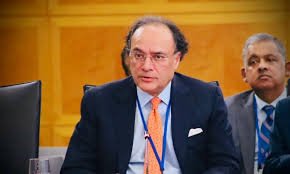
Federal Minister for Finance Muhammad Aurangzeb has said that the government is committed to developing a dynamic and comprehensive capital market system that will play a key role in providing financial support for economic growth, increasing investor participation, and advancing ongoing structural reforms. He expressed these views while addressing the inaugural meeting of the Capital Market Development Council.
The Finance Minister said that developing a modern, integrated, and investor-friendly capital market ecosystem is a national priority, as it is essential for improved access to finance, promotion of savings, increased market depth, and long-term economic stability for Pakistan. The meeting reviewed in detail the roadmap for stabilizing and expanding capital markets. Senior leadership from major financial institutions, corporate sectors, regulators, and various government departments attended, including representatives from the Securities and Exchange Commission of Pakistan, State Bank, Pakistan Banks Association, Pakistan Stock Exchange, Central Depository Company, National Clearing Company, Pakistan Business Council, and the Ministry of Finance.
The meeting discussed the council’s terms of reference, the overall development plan, and strategies for capital market growth. Emphasis was placed on adopting global best practices and systematic approaches to broaden and deepen the market. Four key areas were highlighted: increasing the participation of retail and institutional investors, developing diversified investment products tailored to investor needs, improving facilitation for institutions such as banks, brokers, and mutual funds, and creating incentives for investors and issuers, including cross-border listings, collaborations, and broader market integration.
The meeting also reviewed requirements for cross-border market integration, alignment of market technologies, regulatory modernization, and the need to encourage issuers to raise capital through both debt and equity markets. Participants stressed that greater liquidity, dynamic markets, and transparent price discovery mechanisms are essential to enhance the role of capital markets in national economic development.
The Finance Minister stated that the government aims to establish active and vibrant capital markets that support issuers in raising capital and provide investors with safe and attractive opportunities. He added that ongoing structural reforms are strengthening market performance, and both government and private sectors must make greater use of the debt capital market. He urged the council to identify and address barriers hindering private-sector participation, noting that the core function of capital markets is to connect institutions needing capital with individuals and entities that have savings, through transparent and efficient equity and debt instruments.
The meeting also reviewed regulatory, taxation, and incentive frameworks, including discussions on improving regulatory oversight, offering incentives for company listings, and developing tax policies to enhance product innovation and market competitiveness.
The Finance Minister said that taxation is a significant factor affecting capital market attractiveness. He instructed the Tax Policy Office, State Bank, SECP, DMO, and Ministry of Finance to jointly review the capital market tax system, tax incentives for issuers, and measures to promote broader listings and greater transparency.
The meeting emphasized recognizing transparent and compliant companies. The Finance Minister also instructed that the council secretariat integrate the government’s recently announced three-phase digitization policy with the Capital Market Development Roadmap. It was decided that special working groups will be formed in priority areas, which will prepare key performance indicators and actionable plans within the next two weeks.
The council will receive quarterly progress reports, and at least one meeting will be held each quarter to monitor implementation and outcomes. The meeting was informed that these initiatives aim to establish a dynamic, resilient, and highly liquid capital market ecosystem that channels savings into productive investments, supports economic growth, and strengthens Pakistan’s overall financial stability.