According to reports, the government has released the country’s first Digital Household Integrated Economic Survey 2024–25, which shows significant improvements in literacy, internet access, and vaccination coverage.
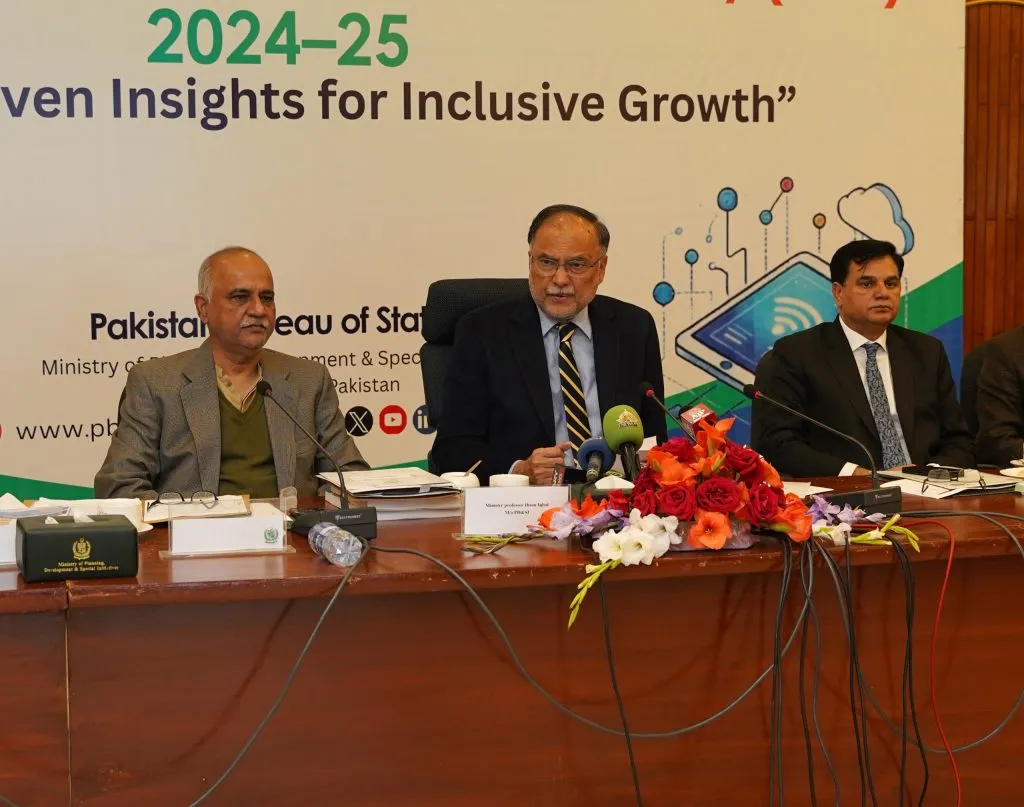
Sources said that Federal Minister for Planning, Ahsan Iqbal, officially inaugurated the Household Integrated Economic Survey 2024–25. The inauguration ceremony was held at the Ministry of Planning, Development, and Special Initiatives, hosted by Chief Statistician Dr. Naeem Uz Zafar (Sitara-i-Imtiaz), Muhammad Sarwar Gondal (Sitara-i-Imtiaz), Member SS/RM, and Deputy Director General PSLM/PCS Rabia Awan.
According to the survey released by the Pakistan Bureau of Statistics, notable improvements have been recorded in education, health, digital access, and various quality-of-life indicators. National literacy has risen from 60 percent to 63 percent, while the percentage of out-of-school children has decreased from 30 percent to 28 percent.
Household internet access has shown a remarkable increase, rising from 34 percent to 70 percent, and the proportion of internet users has jumped from 17 percent to 57 percent. Full vaccination coverage has increased from 68 percent to 73 percent, and the use of clean fuel has risen to 38 percent. The Household Integrated Economic Survey (HIES) has been monitoring social and economic indicators at national and provincial levels since 1963. Household access to mobile or smart phones has reached 96 percent.
Gender parity in early education has improved from 92 percent to 96 percent. The neonatal mortality rate has dropped from 41 to 35 per thousand live births, and infant mortality has decreased from 60 to 47 per thousand live births.
A slight decrease in the overall birth rate was recorded, while household income and expenditures have increased, with the largest portion of national spending going to food (37 percent) and housing & fuel (26 percent).
Federal Minister for Planning and Development, Ahsan Iqbal, said that transforming the Ministry of Planning and the Pakistan Bureau of Statistics into modern, data-driven institutions is a major achievement. He emphasized that increasing school enrollment to 90 percent is essential and that the literacy crisis must be addressed urgently, as true development is not possible without near-universal literacy.
He highlighted the effective implementation of the “5Es” framework under the Udaan Pakistan initiative, political stability, and continuity of policies as key to sustainable development, reiterating the government’s commitment to making Pakistan a trillion-dollar economy by 2035.