
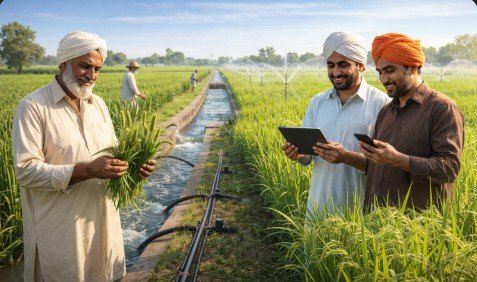
The Punjab Resilient and Inclusive Agriculture Transformation (PRIAT) project, funded by the World Bank, has made significant progress in improving water efficiency, increasing agricultural productivity, and boosting farmers’ incomes.
According to sources, the World Bank’s latest Implementation Status and Results report rated the project’s overall performance and achievement of development objectives as satisfactory. Valued at $204.44 million, the project is financed through the International Development Association and implemented by the Punjab Agriculture Department. More than half of the project’s total duration has already been completed. To date, $139.87 million has been spent, representing approximately 70 percent of the revised cost. Both in terms of achieving development objectives and overall implementation, the project has been rated satisfactory, while overall risks are considered moderate.
The core objective of PRIAT is to improve equitable access to agricultural water and increase water productivity. Since becoming effective in November 2022, over 5,560 watercourses across Punjab have been rehabilitated and improved, achieving 71 percent of the planned target. These interventions have particularly benefited tail-end farmers, who historically faced water shortages and irregular supply.
The report states that water availability at the tail ends of watercourses has increased by 41 percent, improving crop performance and reducing conflicts over water use. Additionally, modern high-efficiency irrigation systems, such as drip and sprinkler systems, have been installed across more than 8,048 hectares, achieving 50 percent of the target. These systems have reduced water loss and energy costs while helping farmers adapt to increasing water scarcity caused by climate change.
Overall, the project has benefited over 1 million people in Punjab. Initial field surveys indicate a significant increase in water productivity, with wheat yields per unit of water rising by 41 percent and rice yields by 71 percent.
PRIAT has also encouraged farmers to shift toward higher-value and climate-resilient crops. According to the report, the area under high-value crops among beneficiary farmers has increased by 38 percent, which is expected to improve incomes and provide protection against price fluctuations.
Under the project, 181 Farmer Entrepreneur Groups, comprising 2,330 farmers, are implementing business plans and linking with agribusinesses in value chains for crops such as mango, kinnow, tomato, onion, and peanuts.
The project fully complies with the World Bank’s environmental, social, and financial requirements. PRIAT was approved on July 15, 2022, and is expected to be completed by June 30, 2027.