ISLAMABAD: Pakistan’s government scrambled Saturday to close the gaps in its flagship fuel subsidy program, signing off on SMS-based token redemption for stations beyond the reach of the internet and ordering that no working fuel pump be left off the rolls.
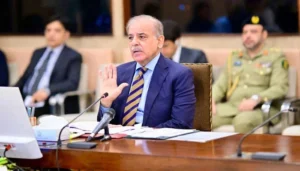
Sen. Mohammad Ishaq Dar, the deputy prime minister and foreign minister, chaired a meeting of the National Steering Committee on Fuel Subsidy to take stock of the Prime Minister’s Special Relief Scheme. The committee agreed to let stations in areas without internet connectivity redeem fuel tokens by text message, with Azad Jammu & Kashmir, Gilgit-Baltistan and the provinces to supply lists of those stations so they can be folded into the program quickly.
Dar’s instruction was blunt: every station that is open and pumping fuel must be on the system. Stations that have shut for good or sell only diesel, he said, should be struck from the list so the scheme’s reach matches reality on the ground. He credited the provincial administrations for their efforts and thanked the State Bank of Pakistan for its cooperation, reminding those present that the relief has to keep flowing to the people it was designed for.
The room was crowded with heavyweights — the ministers for petroleum, economic affairs, information and broadcasting, and IT and telecommunication; the deputy governor of the State Bank; the chairmen of OGRA and the Pakistan Digital Authority; the petroleum secretary; the chief commissioner of Islamabad; and senior officials from Punjab, Khyber Pakhtunkhwa, Balochistan, AJK and GB.
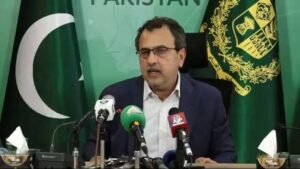
In a separate briefing, Federal IT and Telecommunication Minister Shaza Fatima Khawaja rolled out three changes meant to make life easier for the scheme’s most numerous beneficiaries: motorcycle, rickshaw and Qingqi riders.
First, the eligibility window has been pushed back. Motorcycles registered from Jan. 1, 2006, now qualify, replacing the old 2011 cutoff — a fix, she said, prompted by complaints from citizens and journalists about older bikes being shut out.
Second, the 500-rupee cap per token for two- and three-wheelers is gone. So is the five-liter ceiling. Riders can now buy as much fuel as they need, with four tokens a month available to eligible users, each worth 500 rupees in relief. Khawaja offered a simple illustration: if two liters of petrol cost 780 rupees, the beneficiary pays 280 rupees once the token is applied.
Third, SMS charges have been scrapped for everyone. “SMS has been made free for everyone, whether they own an 800cc vehicle or a two or three-wheeler,” she said.
By 3 p.m., more than 1.75 million registrations had been logged, roughly 1.5 million tokens generated and over 680,000 redeemed at petrol stations, according to the minister. Prime Minister Shehbaz Sharif, she said, is tracking the rollout personally, while a steering committee under the deputy prime minister and a separate implementation committee work through problems with the ministries, OGRA, the State Bank and others. A 24-hour control room at the Ministry of IT and Telecommunication is now taking complaints.
Khawaja had a warning for the public: fraudsters are circling. The government charges nothing for registration, SMS or tokens, she said. “No one should pay anyone for registration, tokens or information about the scheme.” Citizens should guard their CNIC numbers, vehicle registration details and other personal data, and report problems at petrol stations or during registration by calling 9771 — a line also open to pump operators using the token-validation app.
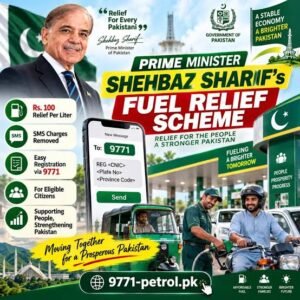
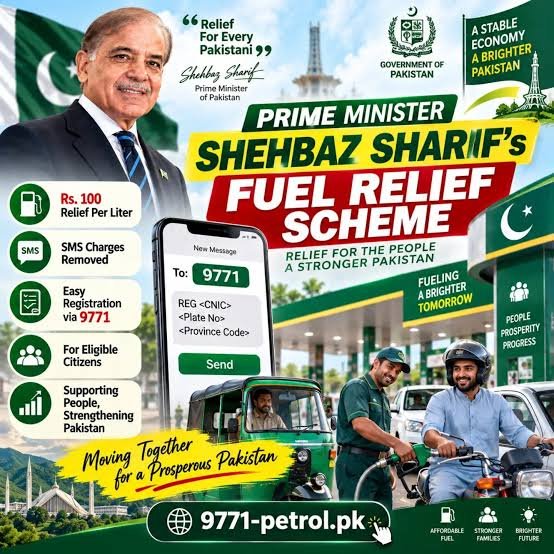
Registration, she explained, takes a single text to 9771 containing the CNIC number, vehicle registration number, province code and registration date, entered without spaces. The registration date was added to stop vehicles from being signed up without authorization.
Ownership papers, she noted, are not strictly required — documents and custody of the motorcycle, Qingqi or rickshaw will do. Two- and three-wheeler users can text “TOK” to 9771 once a week for a token; car owners follow a set schedule.
The whole system, Khawaja stressed, runs on plain SMS so that people without smartphones or internet access are not left behind. Feedback, she added, is being reviewed continuously, and more changes will come where they are needed.