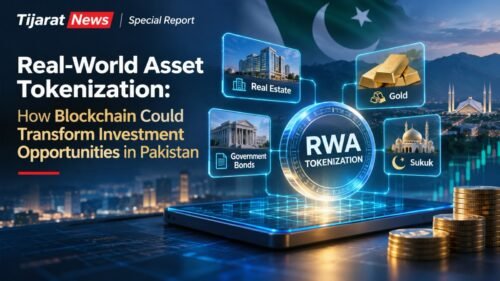
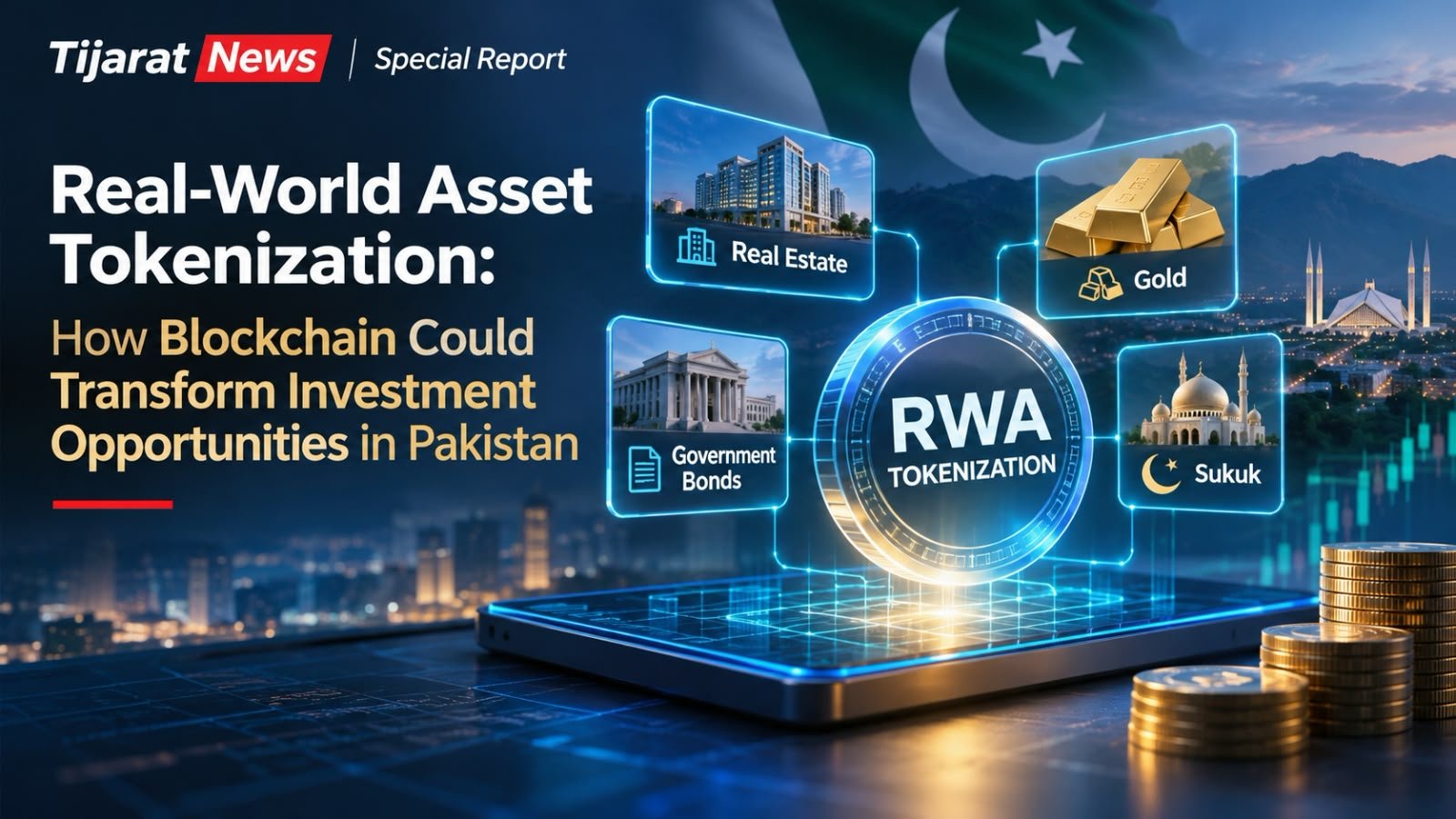
From gold and real estate to government bonds and Sukuk, a new wave of financial innovation is changing how assets can be owned, traded and accessed. As global institutions move into tokenized investments, Pakistan is beginning to explore what this technology could mean for its economy:
ISLAMABAD: November 17, 2026: Imagine being able to invest in a small portion of a valuable commercial property without having to purchase the entire building. Or buying a fraction of a gold-backed investment through a regulated digital platform, with ownership records maintained on blockchain technology.
What once seemed like a futuristic concept is gradually becoming part of the global financial landscape.
The technology behind this shift is known as Real-World Asset (RWA) Tokenization, and it is attracting growing attention from banks, investment firms, regulators and governments around the world.
At its simplest, tokenization involves creating a digital representation of an asset or financial right on a blockchain. These digital tokens can represent interests in assets such as real estate, gold, government securities, corporate bonds, Sukuk and investment funds.
The underlying assets remain in the real world. What changes is the way investment rights can be recorded, transferred and, potentially, traded.
Making Investment More Accessible
Traditionally, investing in high-value assets has required substantial capital. Commercial properties, large investment portfolios and certain institutional financial products have often remained beyond the reach of smaller investors.
Tokenization could help change that.
Consider a commercial property valued at $1 million. Under an appropriately structured tokenization arrangement, the investment could be divided into 10,000 digital units, each initially representing
$100 of economic exposure.
Instead of purchasing the entire property, eligible investors could acquire smaller interests according to their financial capacity.
However, holding a token does not necessarily mean directly owning part of the property. Depending on the legal structure, investors may hold shares in a company, beneficial interests in a trust or
contractual rights linked to the asset.
This distinction is important because the rights attached to a token ultimately determine what an investor actually owns.
Beyond fractional investment, tokenization could also improve recordkeeping, simplify certain transactions and reduce administrative costs.
It may also enable faster settlement and more efficient transfer of assets, although these benefits depend on the underlying infrastructure, regulations and availability of buyers and sellers.
Global Financial Institutions Are Already Participating
Tokenization is no longer confined to experimental cryptocurrency projects.
Major financial institutions have begun applying blockchain infrastructure to conventional investment products, particularly money market funds, government securities and other financial instruments.
BlackRock, one of the world’s largest asset managers, launched its blockchain-based BUIDL fund in 2024, offering qualified investors exposure to a tokenized investment structure backed by traditional financial assets.
Other institutions, including Franklin Templeton and JPMorgan, have also developed blockchain-related financial products and infrastructure.
These initiatives demonstrate that tokenization is increasingly being examined as a practical financial-market technology rather than merely a speculative digital asset trend.
The potential extends beyond investment products. Blockchain-based systems could support automated settlement, more transparent transaction records and improved coordination between financial institutions.
Nevertheless, tokenized investments remain exposed to familiar financial risks, including changes in asset values, counterparty failures and liquidity constraints.
Putting an asset on a blockchain does not eliminate those risks.
Pakistan’s Digital Finance Landscape Is Changing
Pakistan is also taking steps toward a more structured digital financial ecosystem.
A significant development came with the Virtual Assets Act, 2026, which established a statutory framework for virtual assets and strengthened the role of the Pakistan Virtual Assets Regulatory Authority (PVARA).
The authority is responsible for regulating and supervising virtual asset activities within its legal mandate, while coordinating with other financial regulators where necessary.
In August 2026, Pakistan introduced further regulations covering virtual asset service providers, including licensing, governance, compliance, technology standards and customer protection.
These developments mark a shift from broad discussions about digital assets toward a formal regulatory framework.
For investors and financial institutions, that distinction matters. A credible regulatory environment is essential if tokenized financial products are to gain public confidence.
Government Bonds and Sukuk Could Be Among the First Opportunities
One of the most promising areas under discussion is the tokenization of sovereign debt instruments.
In May 2026, Finance Minister Muhammad Aurangzeb held discussions with PVARA Chairman Bilal Bin Saqib and government debt-management officials about tokenizing sovereign instruments, including Naya Pakistan Certificates.
The objective was to explore whether regulated blockchain infrastructure could expand investor participation and modernize the distribution of government-backed investment products.
Pakistan’s interest has since extended to possible tokenized bonds and Sukuk, including discussions with international financial institutions.
In October 2026, Pakistani officials engaged with World Bank Group leadership on digital finance, tokenized capital markets and potential cooperation involving bonds and Sukuk.
More recently, in November, the finance minister disclosed that the government was exploring the tokenization of existing Eurobond debt, with Cabinet approval being sought before proceeding toward a formal request for proposals.
These remain exploratory initiatives rather than confirmed public investment offerings.
Nevertheless, they indicate that asset tokenization is increasingly being considered at the highest levels of Pakistan’s financial policymaking.
A Potential Opportunity for Overseas Pakistanis
For millions of overseas Pakistanis, investing back home can involve practical challenges.
Traditional investment channels may require extensive documentation, international transfers, intermediaries and complex administrative procedures.
Properly regulated tokenized investment products could eventually simplify parts of that process.
For example, a digital platform could allow eligible overseas investors to access selected Pakistani government securities or other approved investment products through standardized digital onboarding and transparent transaction records.
Such a system could potentially improve accessibility and reduce operational friction.
However, cross-border investment would still need to comply with foreign exchange regulations, investor eligibility rules, taxation requirements and anti-money-laundering controls.
The opportunity is significant, but its success would depend on regulatory coordination and public trust.
Could Real Estate and Gold Be Next?
Beyond government securities, Pakistan has several sectors where tokenization could eventually offer practical applications.
Real estate is one example. A properly regulated structure could allow investment in commercial properties, rental-income portfolios or development projects through smaller digital units.
Gold and other commodities could also be represented through asset-backed tokens, provided that the underlying reserves are independently verified, securely held and subject to transparent redemption arrangements.
For Islamic finance, tokenized Sukuk could offer another avenue for innovation, combining digital infrastructure with established Shariah-compliant investment structures.
However, tokenization alone does not make a financial product Shariah-compliant. The underlying transaction, asset ownership, contractual rights and income structure would still require appropriate Shariah review.
Technology Alone Cannot Guarantee Investor Protection
Despite its potential, RWA tokenization is not a shortcut to secure or profitable investment. A digital token is only as reliable as the legal and financial arrangements supporting it.
If a token claims to represent gold, investors must be able to establish whether that gold actually exists, who holds it and whether the token provides enforceable rights to it.
Similarly, a token linked to real estate must be supported by verifiable property records, a legally sound ownership structure and clear investor protections.
Cybersecurity, independent audits, custody arrangements and transparent disclosures are equally important.
Liquidity is another concern. Even when a token can technically be transferred around the clock, investors may not always find someone willing to buy it at a fair price.
Without proper safeguards, tokenization could introduce new forms of financial risk rather than solve existing problems.
The Road Ahead for Pakistan
Pakistan has an opportunity to participate in the next stage of global financial innovation, particularly in capital markets, Islamic finance and investment products designed for overseas Pakistanis.
But technology alone will not determine the outcome.
The real test will be whether policymakers, regulators, banks and financial institutions can develop a system that combines innovation with enforceable investor rights, transparent asset backing and effective supervision.
A carefully implemented tokenization framework could help modernize financial infrastructure, broaden access to selected investment opportunities and potentially attract additional capital.
For Pakistan, the question is no longer simply whether blockchain technology has a role in finance.
The more important question is whether the country can turn that technology into a financial system that investors can understand, access and trust.
Tijarat News | Business, Finance & Digital Economy
*Special Report | November 2026*