
Gul Plaza Tragedy: Accident or Negligence?
A hard-hitting investigative report by Tijarat News
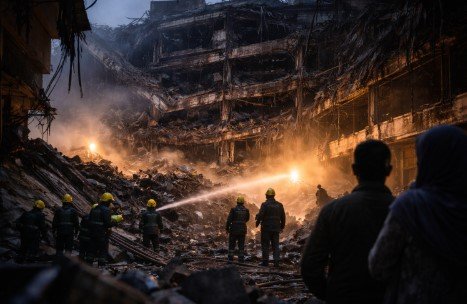
The horrific fire that broke out at Gul Plaza shopping mall on M.A. Jinnah Road in Karachi late Saturday night, January 17, was finally brought under control after more than 36 hours. Two sections of the building collapsed due to the blaze. After the initial phase of fire control, rescue operations and debris removal are still underway to search for the missing.
According to reports, the death toll has risen to 28, including one firefighter. So far, only eight victims, including one woman, have been identified. More than 80 people remain missing. Their families have been waiting for days in deep anguish, ignoring hunger, thirst, cold weather, and all worldly needs, staring at the ruins of Gul Plaza with fading hope. With every passing hour, their chances of finding loved ones alive continue to slip away.
Tijarat News stands shoulder to shoulder with the bereaved families and the trader community who lost precious lives in this national tragedy.
At a time when Pakistanis at home and abroad are grieving, elected representatives from federal and provincial governments, along with opposition parties, are once again engaged in political point scoring. Meanwhile, the city government and its subordinate institutions are declaring themselves completely innocent, trying to shift all responsibility onto officials posted in government departments three decades ago.
What is clearly missing is modern rescue equipment and trained personnel. As a result, rescue efforts have been painfully slow from the very beginning. This delay has fueled anger and anxiety among affected families, traders, and the general public. Karachi’s air is once again heavy with smoke, ash, and muffled cries.
The fire at Gul Plaza was not just an accident. It was a full-scale tragedy, a collective failure, and a reflection of a system that survives only in files, statements, and formalities, but fails to protect citizens’ lives and property in practice.
Within hours, a major commercial hub was reduced to rubble. A place that supported the livelihoods of thousands. A building where traders had invested their life savings. Where young people’s dreams and elders’ lifetime earnings existed side by side. All of it turned to ashes.
One of the most disturbing aspects is that it took more than 36 hours to control the fire. During this time, two major portions of the building collapsed, making rescue work harder and exposing the poor construction quality and lack of safety measures. Fire brigade and rescue teams tried their best, but limited resources, outdated equipment, lack of training, and weak planning allowed the damage to grow.
Eyewitnesses say the actual death toll may be much higher. Gul Plaza reportedly housed around 1,200 shops. Being a Saturday night, many shops had staff, laborers, and even owners present. Many lives were lost to flames or crushed under debris. Unidentified bodies stored temporarily in morgues show how even dignity and identification have become uncertain.
For families, this is not just news. It is endless pain. A father waiting for his son. A mother clutching her child’s photo. A wife running from list to list, hoping to see a familiar name. These scenes should awaken any society.
But the real question is, do we ever truly wake up? Or do we repeat the same cycle after every tragedy: brief sympathy, official statements, inquiry committees, and then business as usual?
Gul Plaza is not an isolated case. Fires at Cooperative Market, Arshi Shopping Mall, RJ Mall, Ayesha Manzil, and other locations already warned us that Karachi’s commercial buildings are ticking time bombs. Yet every time, responsibility is avoided by calling it an accident or short circuit.
Initial reports again point to a short circuit. But is a short circuit a natural disaster, or the result of faulty wiring, substandard electrical equipment, overloading, and illegal connections?
Tijarat News’ ongoing investigation reveals that most shopping centers in Karachi still operate on electrical systems installed decades ago, when shop numbers and power usage were far lower. Over time, illegal alterations multiplied. Compliance with safety laws is reportedly below 2 percent. Fire alarms, sprinklers, firefighting equipment, and clear emergency exits are legally required but mostly absent or nonfunctional. Gul Plaza was no exception.
Emergency exits were blocked or narrowed by stored goods. Firefighting equipment existed in name only. This exposes clear negligence by authorities like the Sindh Building Control Authority, municipal bodies, fire services, and other departments, which allegedly ignored violations in exchange for bribes. Illegal constructions, extra floors, basement shops, and warehouses flourished in plain sight.
Still, government bodies are not the only ones to blame. Shop owners, trader unions, and plaza management share responsibility. Safety audits are often resisted as unnecessary costs. Space meant for emergency exits or safety systems is converted into shops or storage to increase profit.
According to reliable sources, Gul Plaza housed goods worth billions of rupees. Yet basic safety measures were ignored. Within hours, everything was destroyed.
The economic impact will extend far beyond one plaza. Karachi is Pakistan’s economic hub. Damage here affects the entire country. Gul Plaza supplied goods nationwide. Its destruction disrupts supply chains, causes unemployment, and raises fears of shortages and inflation. Loans, credit purchases, and pending orders were all wiped out in minutes.
If this pattern continues, investor confidence will collapse, and businesses may shrink or leave the city. This is not just Karachi’s loss. It is Pakistan’s loss.
Unless building control, fire safety, urban planning, and commercial regulations are enforced seriously, such tragedies will continue. Unless bribery and favoritism are eliminated, buildings will remain death traps. Unless traders prioritize safety over profit, losses will repeat.
Trader associations must move beyond protests and demands and embrace self-accountability. Safety audits should be seen as investment, not burden. Spending a few million today can prevent losses of billions and save lives tomorrow. The government must enforce mandatory safety certification for commercial centers, no matter the pressure.
The flames of Gul Plaza have once again held up a mirror to our system, exposing weak priorities, flawed governance, and collective apathy. If we fail to learn, these flames will consume another market, another plaza, another family.
The burned dreams of Karachi and its neglected citizens ask a simple question:
Are we only alive to mourn, or do we have the courage to learn and change?
The choice is ours. Every delay invites the next fire.