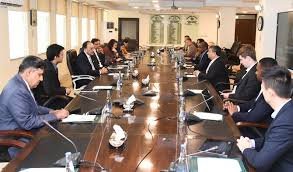
Federal Minister for Finance, Senator Muhammad Aurangzeb, reaffirmed Pakistan’s strong commitment to macroeconomic stability, structural reforms, and investor facilitation during a meeting with a delegation of German investors and business leaders, led by German Ambassador to Pakistan, Anna Lepel.
In the meeting, the finance minister shared details of the government’s continued progress in restoring fiscal and external stability, noting a stable currency, declining inflation, and renewed confidence from international financial institutions and credit rating agencies.
He highlighted that Pakistan’s current economic strategy is centered around deep structural reforms, particularly in taxation, energy, privatization, and public finance, aimed at creating a sustainable and competitive economy.
Aurangzeb invited German investors to explore the expanding opportunities in Pakistan’s key sectors — especially technology, energy, and manufacturing — while underlining the government’s efforts to revive investor confidence and re-enter global capital markets.
The minister appreciated the role of the AHK German-Pakistan Chamber of Commerce, which he said has been instrumental in helping German investors understand Pakistan’s evolving business landscape and identify viable investment prospects.
Aurangzeb also briefed the delegation on Pakistan’s recent macroeconomic progress and reform initiatives, sharing insights from his recent visit to Washington, D.C., where he attended the IMF and World Bank Annual Meetings and engaged with multilateral institutions, global investors, credit rating agencies, and international counterparts.
He emphasized that Pakistan is consolidating its macroeconomic gains, with a stable exchange rate, foreign exchange reserves sufficient for 2.5 months of imports — expected to rise to three months by fiscal year-end — and inflation projected between 5% and 7% for FY26, supported by lower policy rates.
The finance minister noted that Fitch, S&P, and Moody’s have all recently upgraded Pakistan’s outlook, reflecting improved confidence in the country’s policy direction. The recent IMF staff-level agreement following the comprehensive review mission also underscores international trust in Pakistan’s reform agenda.
Discussing key reform areas, Aurangzeb said broadening and deepening the tax base remains a top priority. The government aims to raise the tax-to-GDP ratio from 10.2% to 11% this fiscal year and to 13% in the coming years.
In the energy sector, he reaffirmed the government’s commitment to sustainable reforms and privatization, focused on reducing losses and improving recoveries. He revealed that 34 state-owned enterprises (SOEs) have been transferred to the Privatization Commission, with notable progress marked by a recent acquisition by a UAE-based firm.
He also confirmed that the privatization of Pakistan International Airlines (PIA) is underway, with four major international groups currently conducting due diligence.
Aurangzeb highlighted ongoing public finance reforms, including pension restructuring and the closure of dormant federal entities, which he described as politically challenging but fiscally essential steps.
He further shared Pakistan’s plans to re-enter international capital markets, including the issuance of its first Panda Bond in China’s deep capital market and a return to the Eurobond market in 2026.
The finance minister concluded by noting that improved macroeconomic fundamentals, favorable geopolitical positioning, and renewed partnerships with major stakeholders — including Europe, China, the United States, and Gulf nations — are helping to create a conducive environment for foreign investment and business collaboration.
During the discussion, Aurangzeb also addressed questions from the German delegation on IT export promotion, profit and dividend repatriation facilities for foreign firms, and measures to enhance investor confidence in Pakistan’s long-term economic trajectory.