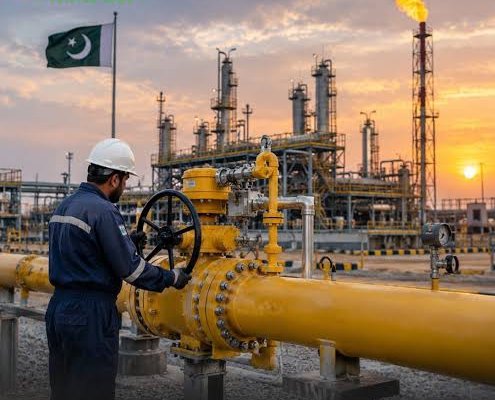
ISLAMABAD: The government is preparing to restructure and deregulate the gas sector in phases to deal with circular debt, cross-subsidies and system losses, and to make gas utilities financially viable while attracting private investment, officials said Monday.
The plans were announced at a high-level meeting chaired by Federal Minister for Finance and Revenue Muhammad Aurangzeb to review the proposed roadmap for the gas sector. The meeting focused on financial sustainability, operational efficiency, consumer welfare and greater private-sector participation.
The reforms aim to create a financially sustainable, efficient and competitive gas market that supports businesses, encourages private investment and protects consumers. The meeting discussed a phased move toward greater competition, supported by effective regulation, better operational performance and a more sustainable approach to gas pricing and supply.
Official sources said gas sector circular debt rose to 3.63 trillion rupees, including a principal amount of 1.848 trillion rupees. Late payment surcharges added another 1.783 trillion rupees to total outstanding liabilities at the end of June 2026.
The principal amount included 1.448 trillion rupees in tariff differential, 131 billion rupees owed by power companies, 210 billion rupees in sales and income tax receivables, and 59 billion rupees tied to litigation.
Gas circular debt grew by 344 billion rupees during fiscal year 2025-26, from 3.288 trillion rupees on June 30, 2025, to 3.631 trillion rupees by June 30, 2026. The principal amount rose by 17 billion rupees, from 1.831 trillion to 1.848 trillion rupees, while late payment surcharges increased by 327 billion rupees, from 1.456 trillion to 1.783 trillion rupees.
Meeting participants reviewed key challenges in the sector, including circular debt, cross-subsidies, unaccounted-for-gas losses and supply-demand imbalances. They discussed ways to address legacy liabilities, improve the financial health of gas utilities and make sure existing financial pressures do not undermine the proposed market structure or put an undue burden on consumers.
Participants identified a sustainable resolution of legacy circular debt and a clear approach to cross-subsidies as important for the viability of restructured entities and the move to a competitive market.
The meeting also discussed the expected outcomes of the reforms. These include better energy security, more private-sector investment, reduced fiscal and sovereign risks, more business-to-business transactions, more stable and sustainable gas pricing, better access to competitively priced gas for exporters, and lower system losses through stronger efficiency benchmarks and performance-based incentives.
Aurangzeb stressed the importance of getting all stakeholders behind a practical and workable reform plan. The proposed framework draws on international experience, including gas-sector reforms in Türkiye and the United Kingdom, while taking into account Pakistan’s institutional structure, market conditions and consumer interests.
Participants also stressed the need for careful sequencing to protect security of supply, safeguard regulated consumers and create a predictable environment for private-sector participation.
The proposed framework will be presented to the prime minister. After that, further technical work and stakeholder consultations will help refine the reform approach and support an orderly transition.
The meeting reaffirmed the government’s commitment to advancing gas-sector reforms in a phased and consultative manner to strengthen financial sustainability, improve operational efficiency, attract investment and develop a more competitive gas market while safeguarding consumer interests.
The meeting was attended by the federal minister for petroleum, the adviser to the prime minister on privatization, the special assistant to the prime minister on energy, senior officials from the Petroleum and Finance Divisions, representatives of gas utilities and a World Bank team.