
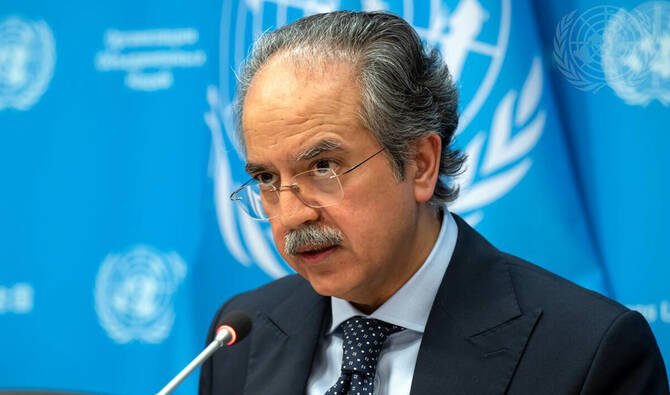
A senior Pakistani diplomat has expressed grave concern at the United Nations Security Council (UNSC) over India’s unilateral suspension of the 1960 Indus Waters Treaty (IWT) and demanded that New Delhi immediately restore compliance with the agreement.
Aasim Iftikhar, Pakistan’s Permanent Representative to the UN, told the 15-member Council that India’s action is not only a threat to Pakistan but also undermines confidence in international water laws and sets a dangerous precedent for using resources to exert pressure on other nations.
He stated that India suspended the World Bank-brokered treaty, which governs the distribution of water from six rivers in the Indus Basin between the two countries, following the Pahalgam incident in April this year.
The Pakistani Ambassador termed this a classic example of the deliberate weaponization of shared natural resources. He noted that for six decades, the treaty has been the standard for the fair and predictable distribution of water between Pakistan and India, even during times of war.
Aasim Iftikhar emphasized that India’s unilateral suspension damages both the spirit and the letter of the agreement, endangers the ecosystem, affects data sharing, and jeopardizes the lives of millions who depend on the Indus River for food and energy.
He clarified that no clause in the IWT allows for unilateral suspension or modification, and the 2025 decision by the Court of Arbitration reaffirmed the treaty’s legal validity and dispute resolution mechanism.
The Pakistani Ambassador said, “We expect full respect for the treaty, the earliest restoration of compliance, and its normal implementation.”
Addressing Environmental Impact of Conflicts
Speaking on the International Day for Preventing the Exploitation of the Environment in War and Armed Conflict, the Pakistani Ambassador stressed the need to address the environmental impacts of conflicts and climate risks by prioritizing conflict prevention, early resolution, and integrating environmental factors into UN peacekeeping missions.
He also highlighted the necessity of adhering to international law, especially international humanitarian law, which includes principles like distinguishing between civilian and military targets, protecting civilians, and avoiding severe damage to the natural environment.
The Ambassador urged for harmonization within the UN system and called for climate and biodiversity funds to be new, additional, predictable, and grant-based, ensuring they are not double-counted with debt or development funds.
Inger Andersen, Executive Director of the UN Environment Programme (UNEP), noted that conflicts lead to environmental damage, resulting in people suffering from hunger, disease, and displacement.
She cited the situations in the Gaza Strip and Haiti as examples. Andersen said the link between climate change and conflict is complex, and severe rainfall or drought could intensify violent conflict in certain areas.
Andersen stressed the need to restore the capacity for environmental governance in conflict-affected countries and for the UN system to play an active role in providing credible knowledge.