
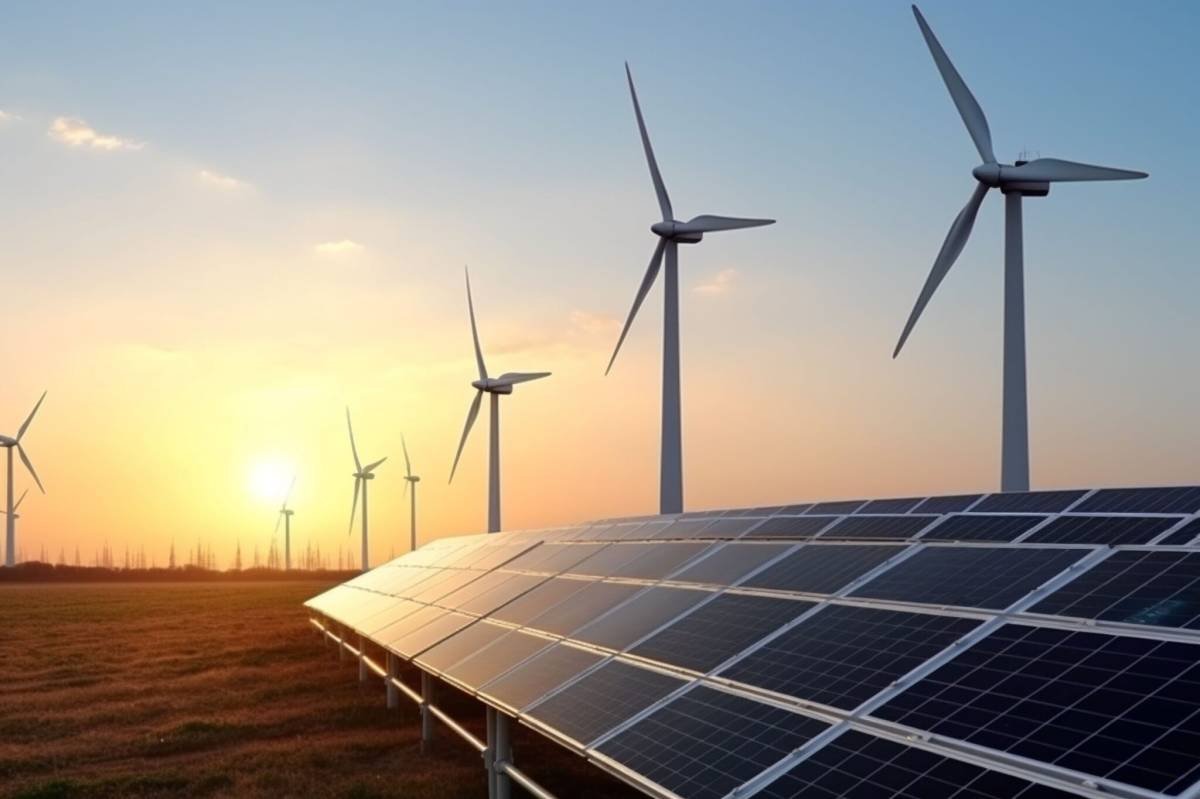
The National Assembly was informed yesterday that the country is making significant progress toward an environmentally friendly future. The government has set targets to increase the share of renewable energy in the national grid to 40% by 2025 and 60% by 2030.
In a written reply to lawmakers’ questions, Minister for Energy (Power Division) Awais Leghari said that Pakistan has already surpassed its 2025 target, as renewable energy accounted for over 46% of the total electricity generation mix by September 2025. He clarified that the share of on-grid renewable capacity currently stands at 37%, but this figure is expected to rise significantly as projects from both the public and private sectors continue to come online.
Awais Leghari stated that 60 private-sector renewable energy projects developed under the Private Power and Infrastructure Board (PPIB) are currently operational, contributing a total of 4,753 MW to the national grid. These include 680 MW of solar power, 1,937 MW of run-of-the-river hydropower, 1,845 MW of wind energy, and 291 MW of bagasse cogeneration.
Additionally, 9,619 MW worth of public-sector hydropower projects and 100 MW of solar capacity in Karachi’s K-Electric are also playing a key role in increasing the share of renewable energy.
He said Pakistan’s clean-energy share has surpassed 46%, achieving the 2025 renewable-energy target several years ahead of schedule. He emphasized the importance of government renewable-energy policies in meeting the country’s long-term energy needs.
He added that net-metering regulations—which allow individuals to share solar or wind-generated electricity with the national grid—are considered a key strategy in expanding renewable-energy use across the country.
He further informed the Assembly that the government is taking measures to improve the power sector, and a reduction of 780 billion rupees in circular debt over the past year is clear evidence of this. Circular debt, one of the major challenges in the energy sector, stood at 2,393 billion rupees on June 30, 2024, which decreased to 1,614 billion rupees by June 30, 2025. He credited this reduction to several steps, including negotiations with power producers to reduce interest on delayed payments and improved performance of distribution companies (DISCOs). He added that the goal is not only to increase renewable-energy capacity but also to ensure a sustainable and efficient energy system for the country.
Federal Minister for Communications Aleem Khan informed the House that the financial pressure faced by Pakistan Post is not limited to Russia, as international liabilities had exceeded 310 million rupees by November 2021. He said the postal department is working to clear its dues and hopes the issue will be resolved once the Finance Division releases the required funds.
He added that the suspension of services has caused severe difficulties for individuals, businesses, and educational institutions relying on international mail. Restoring postal services with Russia as soon as possible remains a top priority.