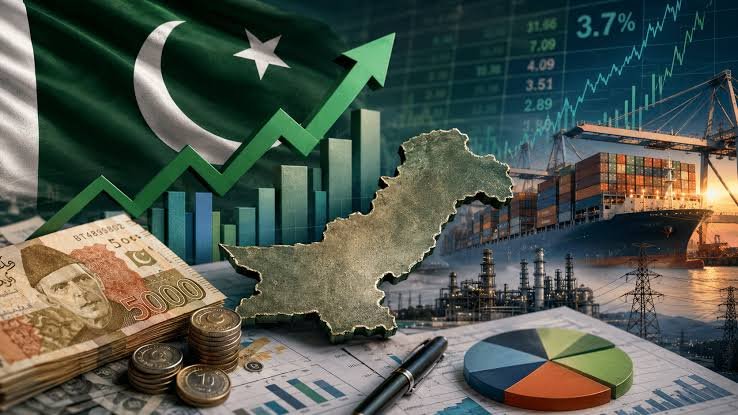
ISLAMABAD: Pakistan’s economy demonstrated resilience against domestic and global shocks in fiscal year 2026, with real GDP growth rising to 3.7% from 3.1% the previous year, according to the State Bank of Pakistan’s Annual Report released Monday.
The report said coordinated macroeconomic policies and reforms under the International Monetary Fund program helped improve key indicators despite uncertainty over U.S. trade tariffs, monsoon floods and the outbreak of a Middle East conflict in late February 2026.
Inflation averaged 7.1% in FY26, close to the upper bound of the central bank’s 5% to 7% target range, though energy price shocks pushed year-on-year inflation above target from March onward. The fiscal deficit more than halved to 2.6% of GDP from 5.4% last year, while the primary balance posted a surplus of 2.9% of GDP.
The State Bank’s foreign exchange reserves rose to $18.4 billion by the end of June, up from $14.5 billion a year earlier, supported by significant central bank purchases and multilateral inflows. Workers’ remittances grew to $41.6 billion.
The current account recorded a marginal deficit of 0.1% of GDP, as robust remittances nearly financed the combined deficit in primary income and trade in goods and services.
Large-scale manufacturing rebounded with 5% growth, driven by higher domestic demand in automobiles, food and beverages, petroleum products and cement. However, export-oriented sectors including textiles and pharmaceuticals remained subdued, and about 35% of manufacturing sub-sectors stayed below their five-year averages.
Exports contracted 4.7% during the year, hurt by weak global demand, closure of western borders and supply chain disruptions. The services trade deficit narrowed considerably, with information and communication technology services emerging as Pakistan’s second-largest export sector after knitwear.
The central bank’s Monetary Policy Committee cut its policy rate by 50 basis points to 10.5% in December 2025, then raised it by 100 basis points to 11.5% in April 2026 to contain second-round effects from the energy price shock.
Sovereign credit ratings were upgraded during FY26, and the country raised $3 billion through a Eurobond issuance in September 2026.
Looking ahead, the State Bank projects GDP growth of 3.5% to 4.5% in FY27 and inflation of 5.5% to 7.5%. It expects the fiscal deficit to range between 3.0% and 4.0% of GDP.
The report warned that the outlook is vulnerable to risks from the ongoing Middle East conflict, new trade blocs and climate change. It also flagged weak investment trends in export-oriented sectors and stagnant tax-to-GDP ratio as structural challenges.
“Sustaining these gains requires implementing deep-rooted structural reforms,” the report said, calling for broadening the tax net to under-taxed sectors such as agriculture, real estate and retail, and improving public financial management.