
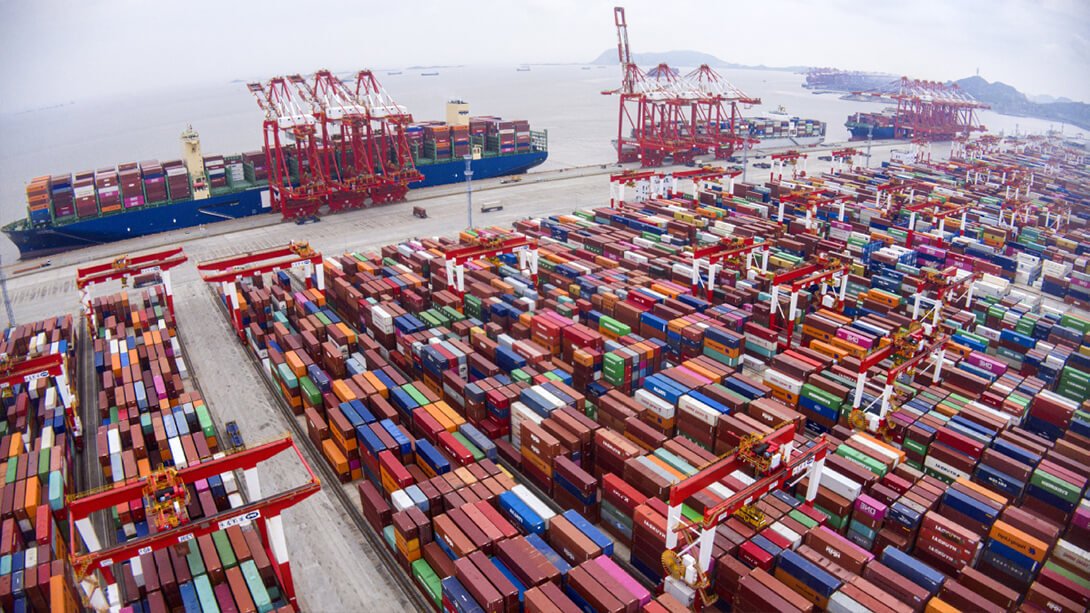
In the current fiscal year, from July to October, negative growth was recorded in all major export categories except textiles, while an increase in petroleum product imports pushed the trade deficit up to $12.7 billion, which is 39% higher compared to last year.
According to the preliminary external trade data released by the Pakistan Bureau of Statistics, exports fell by 4% year-on-year to $10.4 billion during the first four months, while imports increased by 15.5%, reaching $12.7 billion during the same period.
In October alone, exports decreased by 4.5% year-on-year, but increased by 14% month-on-month to reach $2.8 billion. Imports in October rose 21.65% year-on-year and 4.84% month-on-month to $6.13 billion.
During July to October, food exports dropped by 35%. Rice was the most affected, with total rice exports falling 46.4%. Basmati rice exports declined 39%, while IRRI-6 and IRRI-9 rice exports fell by almost 49.65%. Due to flood impacts, vegetable and tobacco exports fell by 41% and 28.5%, respectively. Within the food group, only fish & fish preparations (up 12.8%) and fruit exports (11.78%) showed growth.
Textile exports increased 4% overall during July to October. The largest growth was seen in tents, canvas, and tarpaulins (up 32.34%). Other increases included knitwear (8.23%), cotton yarn (7.74%), non-cotton yarn (7.50%), bedwear (6.94%), and ready-made garments (5.11%). Declines were recorded in cotton cloth (12.75%), towels (0.28%), and art/silk/synthetic textiles (0.98%).
In other categories, exports of carpets, rugs, and mats declined 12%, while tanned leather fell 2.45%. Sports goods exports rose 17.74%, with football exports increasing 26%, whereas gloves fell 9.18%. Leather products declined slightly by 0.34%, and footwear exports increased modestly by 1.12%.
During July to October, imports of petroleum products rose 10.47%, crude oil imports increased 13.57%, while LNG imports declined 29.18%. In the textile group, imports of synthetic fiber and used clothing increased 37% and 12%, respectively.
In October, knitwear exports increased 3.27% month-on-month, but fell 0.80% year-on-year. Ready-made garments exports rose 12.46% month-on-month and 3.73% year-on-year, while bedwear exports increased 1.04% month-on-month and 7.25% year-on-year. IRRI-6 and IRRI-9 rice exports dropped 62.5% year-on-year, but grew 71% month-on-month. Basmati rice exports declined 20.29% year-on-year, but rose 31.3% month-on-month.
In October, crude oil imports increased 79.84% year-on-year and 0.15% month-on-month. Petroleum product imports rose 38% year-on-year and 33.6% month-on-month. Palm oil imports rose 19% year-on-year, but dropped 10% month-on-month. Iron & steel scrap imports increased 17% year-on-year and 9% month-on-month.
Additionally, vehicle imports (CKD/SKD) increased 155% year-on-year and 12.73% month-on-month. Mobile phone imports decreased 27.5% month-on-month, but increased 16% year-on-year.