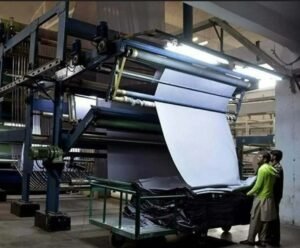
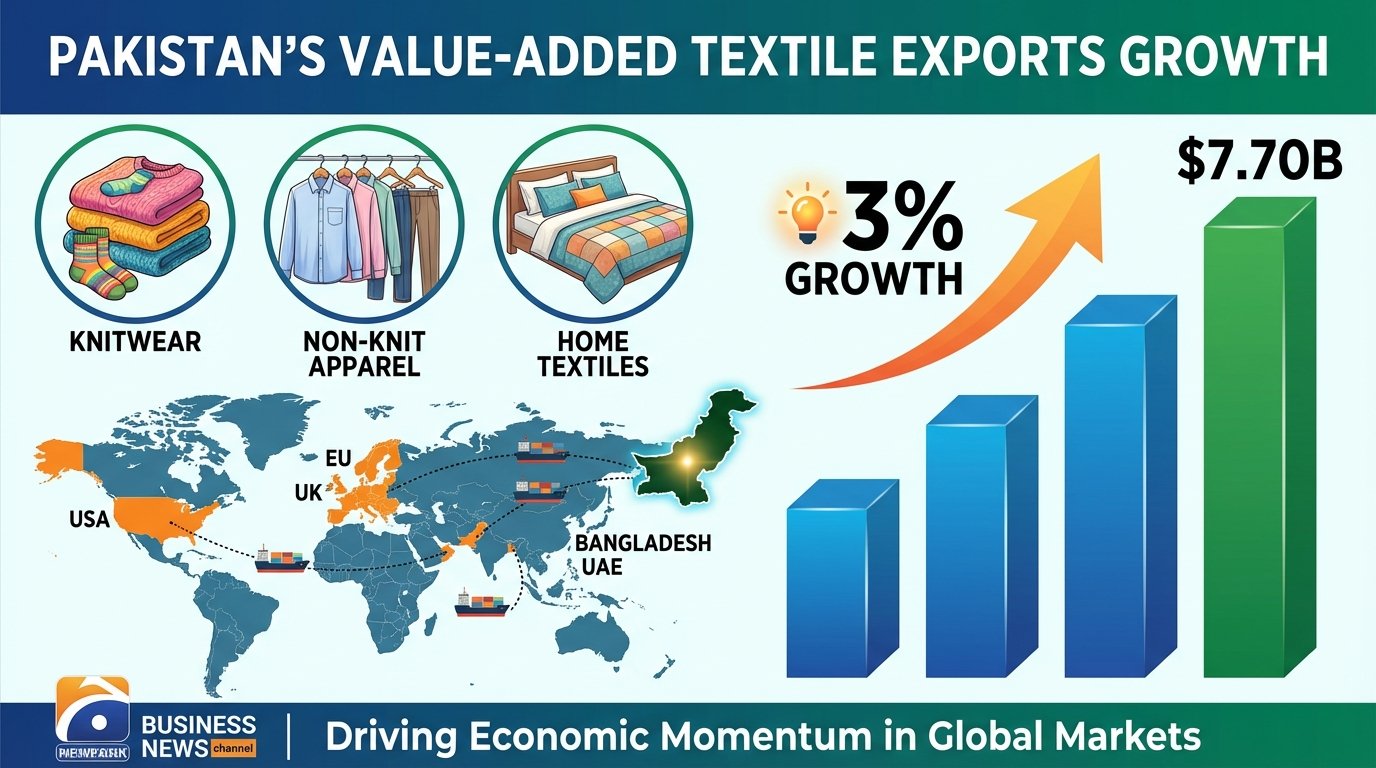
According to sources, the Pakistan Textile Council (PTC) stated that the country’s value-added textile sector — including knitted apparel, woven apparel, and home textiles — showed steady growth, rising over three percent in the first half of fiscal year 2026 to reach 7.70 billion dollars, led by strong performance in knitwear and non-knit apparel.
The textile sector remained the largest contributor to Pakistan’s exports, reaching 9.19 billion dollars in exports from July to December 2025, a one percent increase compared to fiscal year 2025, accounting for roughly 61 percent of total exports. However, in December 2025, textile exports declined nine percent year-on-year and five percent month-on-month.
Performance varied by product within the textile and apparel sector. Traditional textile exports (HS chapters 50–60) fell from 1.65 billion dollars to 1.49 billion dollars, while value-added textile exports (HS chapters 61–63) rose from 7.46 billion dollars to 7.70 billion dollars, showing over three percent growth. Growth was led by knitwear (up 4.1 percent), non-knit apparel (up 4.9 percent), and other finished products (up 1.3 percent).
Export destinations showed mixed trends. The European Union remained Pakistan’s largest market with 3.67 billion dollars in exports, followed by the United States at 2.47 billion dollars. Exports to the United Kingdom reached 892 million dollars, while Bangladesh and the United Arab Emirates received 311 million and 324 million dollars, respectively.
PTC made several policy recommendations for the export sector, including aligning energy prices with regional competitors, adjusting wage and overtime laws to match neighboring countries, reducing taxes, providing zero-rating under the Export Facilitation Scheme, offering export incentives linked to value addition, improving cotton quality and production, strengthening Exim Bank, increasing limits under EFS and LTFF, supporting innovation, and providing financial support for renewable energy and green projects.