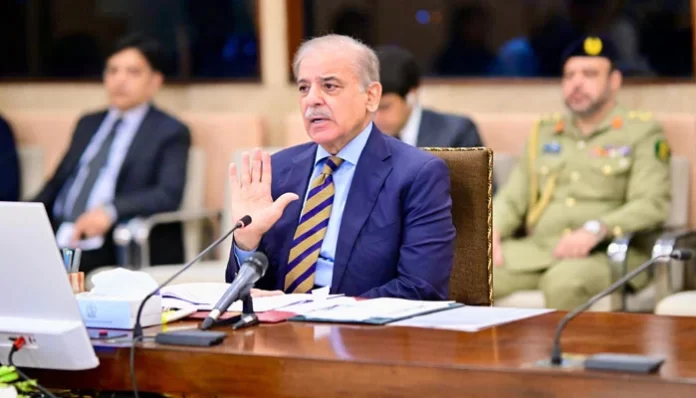
Prime Minister Shehbaz Sharif has constituted a high-level committee to consider the proposal for declaring an export emergency aimed at doubling Pakistan’s exports to $60 billion within four years.
According to information received from sources, this was disclosed by Federal Minister for Planning and Development Ahsan Iqbal during a press conference. Ahsan Iqbal said that the committee will be headed by Deputy Prime Minister Ishaq Dar, who will review proposals related to boosting exports and present final recommendations to the Prime Minister next week.
The federal minister stated that last month, the Ministry of Planning had given a detailed briefing to the civil and military leadership on reducing reliance on the IMF. The briefing included proposals to increase exports to $60 billion within four years and to $100 billion over the next decade. He said that due to the weak performance of the Federal Board of Revenue (FBR), both federal and provincial governments are facing financial pressure. Despite paying 47 percent fewer refunds in December, the FBR faced a tax shortfall of Rs. 330 billion.
As a result, the execution of the development budget was delayed, and during the first half of the fiscal year, only Rs. 210 billion, or 21 percent of the annual budget, could be spent.
According to Ahsan Iqbal, if exports do not increase significantly, Pakistan will once again have to approach friendly countries or the IMF. Pakistan currently owes approximately $13 billion in short-term loans taken from friendly countries.
He also proposed making national holidays optional for export-oriented industries, subject to workers’ consent, as holidays disrupt the export cycle and cause losses worth millions of rupees.
In addition, it has been recommended to the Prime Minister that the top 200 companies with high export potential be given special patronage. The Ministry of Planning has also recommended directing the Board of Investment to expedite the establishment of special and industrial zones, and instructing the Ministries of Foreign Affairs and Commerce to transform diplomatic missions into trade hubs, as well as encouraging overseas Pakistanis to become partners in investment and export growth.
Ahsan Iqbal said that Pakistan faces two choices: either continue with business as usual and grow the economy to $600 billion by 2035, or adopt ambitious targets and strive to become a $1 trillion economy. Over the past 24 years, Pakistan’s exports have increased by only 4.1 times.
He claimed that the economy has stabilized, with GDP growth reaching 3.7 percent in the first quarter, inflation stabilizing, and large-scale manufacturing growing by 5 percent during the first four months of the fiscal year.