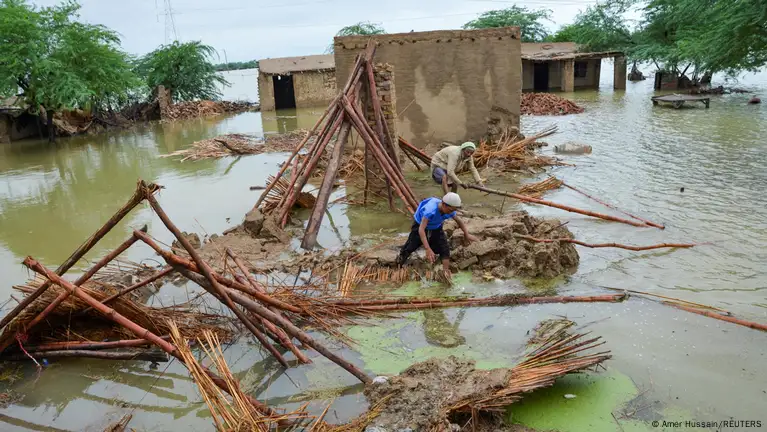
The International Monetary Fund (IMF) has warned that the severe rains and floods expected in the third quarter of 2025 could have a more negative impact on Pakistan’s economic growth, inflation, and current account than current estimates suggest — although the extent of these effects remains highly uncertain.
In its latest report, Regional Economic Outlook: Middle East and Central Asia – Resilience Amid Uncertainty: Will It Last?, the IMF stated that inflation in Pakistan has eased this year due to lower food and energy prices. However, it is expected to rise again in 2026 as prices normalize and temporary electricity subsidies are phased out.
The report projects that Pakistan’s economic growth rate could reach 3.6% in 2026, supported by continued reforms, improved financial conditions, and stronger business confidence. Exports are expected to increase from $40.7 billion in 2025 to $42.1 billion in 2026, while imports are also likely to rise from $70.1 billion to $74 billion. The government’s fiscal deficit is projected to narrow to -4.1% of GDP in 2026, compared to -5.3% in 2025. Total external debt is expected to increase slightly from $30.1 billion to $30.6 billion, while official reserves are projected to grow from $14.5 billion to $17.7 billion.
The IMF cautioned that rising borrowing costs could intensify fiscal and financial challenges in the region, particularly in economies where governments require substantial financial resources and where banks hold a large share of government bonds — such as Pakistan, Algeria, and Egypt. The report noted that non-oil importing countries in the Middle East, North Africa, Afghanistan, and Pakistan (MENAP) region are expected to see improvements in their primary fiscal balances due to tax reforms and reduced energy subsidies.
According to the IMF, ongoing reforms have played a key role in maintaining economic stability across the MENAP and Central Asia (CCA) regions. These include tax and energy sector reforms in Pakistan, energy price reforms in Uzbekistan, and economic diversification initiatives in Jordan, Morocco, and Saudi Arabia. However, the Fund emphasized that further progress is needed in several sectors.
Despite global uncertainty and geopolitical tensions in 2025, the IMF reported that economies in the MENAP and CCA regions have remained relatively stable. It added that even after the expiration of a 90-day pause on U.S. tariffs, most countries have seen tariff levels remain between 10% and 15%, with limited direct impact on exports since these regions’ trade exposure to the U.S. market is only 4.5%, and oil products are exempt from new tariffs.
In Pakistan, remittance inflows continued to grow, while flood-related reconstruction, strong domestic demand, lower energy prices, tourism, and improved agricultural output have helped stabilize economic activity.
IMF Director for the Middle East and Central Asia Department, Jihad Azour, said during a press briefing that regional economies performed better than expected in 2025, and that the effects of U.S. tariffs and geopolitical tensions were short-lived. He noted that Pakistan’s economy is projected to grow by 3.2% in 2025, up from 2.1% in 2024, driven by robust reforms and strengthening domestic demand.