
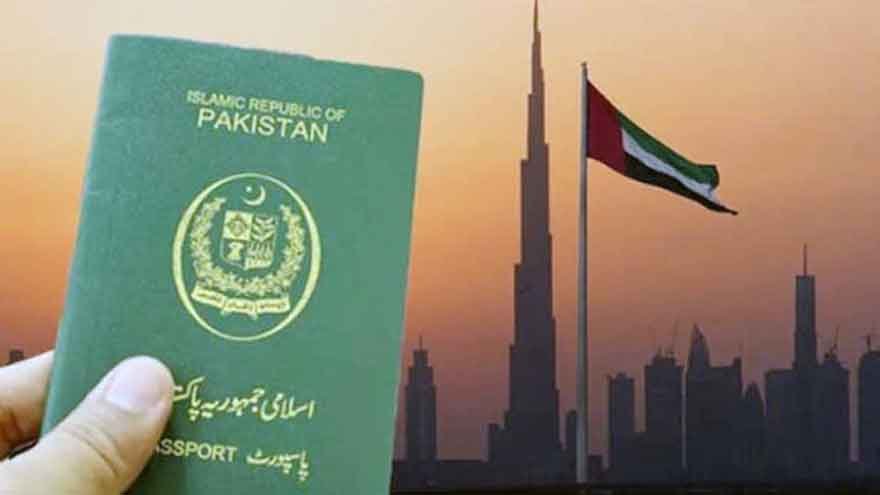
A silent visa restriction imposed by the United Arab Emirates (UAE) has reportedly been in effect for the past two years, due to individuals from more than twenty Pakistani cities being involved in criminal activities. Despite repeated complaints from UAE authorities, Pakistan has not taken effective action.
According to sensitive information obtained by Tijarat News from sources in Islamabad, the issue of severe restrictions on issuing UAE visas to Pakistani citizens has taken a new turn. The UAE has practically halted visa issuance for holders of regular Pakistani passports. Although this decision has not been officially announced, sources say the policy has quietly been in place for the last 18–24 months. The Government of Pakistan has avoided acknowledging it publicly, fearing public backlash and considering the diplomatic sensitivity of the matter.
During a recent Senate Functional Committee on Human Rights meeting, the Interior Ministry officially acknowledged the issue for the first time. Additional Secretary Interior, Salman Chaudhry, informed the committee that UAE visas for ordinary Pakistani citizens are now almost completely stopped, and only diplomatic and official passport holders are being issued visas. He also revealed that Saudi Arabia was close to imposing a full ban on Pakistani passports but delayed the decision at the last moment. According to him, if such a ban is ever formally imposed, reversing it would be extremely difficult.
Committee Chairperson Senator Samina Mumtaz Zahri confirmed this position during the briefing and expressed deep concern. She noted that UAE authorities complain about Pakistani citizens’ involvement in crimes, and that the visa restrictions are essentially a security-based decision. She warned that this situation is alarming not only for millions of Pakistanis but also for the long-standing diplomatic and economic ties between the two countries.
According to sensitive sources, the issue is not recent but ongoing for the past two years. Dubai security authorities have repeatedly warned Pakistan informally that individuals from certain Pakistani regions are frequently found involved in drug dealing, fraud, street crimes, begging, and disappearing after entering UAE on visit visas. Because of this, UAE immigration has marked applicants from these areas as “high-risk”, although no official list has been made public.
Sources claim the unofficial list includes cities such as Quetta, Khushab, Dera Ghazi Khan, Abbottabad, Muzaffarabad, Sargodha, Attock, Dera Ismail Khan, Kurram, Kasur, Nawabshah, Sheikhupura, Bajaur, Hangu, Kohat, Skardu, Larkana, Parachinar, Chakwal, Hunza, Kotli, Sahiwal, Sukkur, Mohmand, and others — over 20 cities in total. UAE authorities believe that applicants from these areas show the highest rate of problematic behavior.
Sources also say the UAE government is unhappy with Pakistan’s failure to fulfill various economic and investment commitments over recent years. Meanwhile, rising crime among Pakistani workers, overstaying visa violations, fake medical reports, and job-seeking on tourist visas have forced UAE immigration to tighten restrictions. Although no official ban exists, the situation has effectively become a no-entry state for ordinary Pakistanis.
Travel sector sources in Islamabad also confirmed the situation, stating that visa rejections have increased significantly over the past year. In many cases, applications are delayed to the point where they become irrelevant. Travel agents say they are informally advised not to submit applications from certain regions, as most are rejected at some stage. However, individuals who already hold residence visas (Iqama) or have strong financial documents face fewer difficulties.
In contrast, Pakistan’s Foreign Office has publicly denied the existence of such restrictions, but sources say these denials are a diplomatic strategy to avoid backlash and pressure from overseas Pakistanis.
Sources warned that if Pakistan does not engage in high-level consultations with UAE leadership in the coming weeks—and if it fails to show progress on labor market reforms, illegal migration controls, and security issues—the situation could worsen further. If UAE formally announces a ban, it will directly impact remittances, the labor market, and the livelihoods of millions of Pakistani families.
Although no official travel ban has been imposed yet, strict scrutiny, thorough screening of applicants from “suspect cities,” and rising rejection rates show that UAE has already tightened its policy for Pakistani citizens. Meanwhile, Pakistan is attempting to downplay the matter, while Dubai authorities continue to silently intensify their checks on Pakistani applicants.